Press archive
Review of Dracula
15 June 1897 · Manchester Guardian
Estate summary
The reviewer admires Stoker’s handling of setting and suspense, finding that a complicated plot holds the reader to the end. Yet the accumulation of horrors is judged an artistic mistake: the critic argues that restraint and mystery could make the supernatural more convincing.
Read the complete historical review
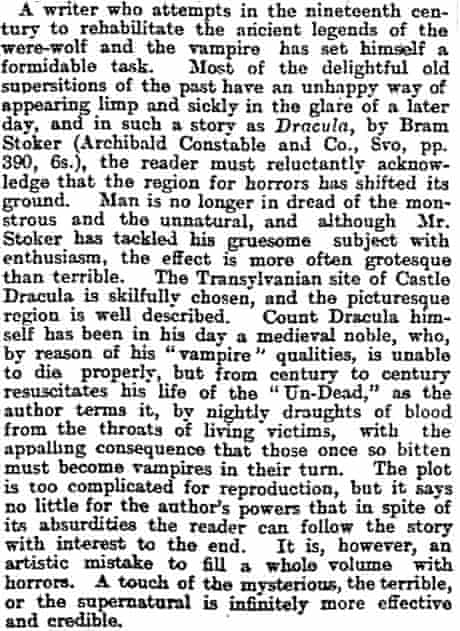
A writer who attempts in the nineteenth century to rehabilitate the ancient legends of the were-wolf and the vampire has set himself a formidable task. Most of the delightful old superstitions of the past have an unhappy way of appearing limp and sickly in the glare of a later day, and in such a story as Dracula, by Bram Stoker (Archibald Constable and Co., 8vo, pp. 390, 6s.), the reader must reluctantly acknowledge that the region for horrors has shifted its ground. Man is no longer in dread of the monstrous and the unnatural, and although Mr. Stoker has tackled his gruesome subject with enthusiasm, the effect is more often grotesque than terrible. The Transylvanian site of Castle Dracula is skilfully chosen, and the picturesque region is well described. Count Dracula himself has been in his day a mediæval noble, who, by reason of his “vampire” qualities, is unable to die properly, but from century to century resuscitates his life of the “Un-Dead,” as the author terms it, by nightly draughts of blood from the throats of living victims, with the appalling consequence that all those once so bitten must become vampires in their turn. The plot is too complicated for reproduction, but it says no little for the author’s powers that in spite of its absurdities the reader can follow the story with interest to the end. It is, however, an artistic mistake to fill a whole volume with horrors. A touch of the mysterious, the terrible, or the supernatural is infinitely more effective and credible.
Original source
Read the full article on the publisher’s website.
Read the original article ↗Link checked 26 October 2026. Publisher pages open in a new tab.
Saved archive record
The title, date, source details and any Estate summary above are saved on this website, so this record remains available if the publisher’s page changes.
The historical text is reproduced above. See the source note for the edition used and any limits on collation.