Explore the towns, rivers and landscapes named in Dracula, alongside its invented and unidentified settings. This map follows the characters’ world, rather than Bram’s travels. For the author’s homes, work and journeys, see Places in Bram’s life.
For places featured in Dracula, we lead with Bram’s name and spelling and explain modern or alternative names in each entry. Bistritz, for example, is known today in Romanian as Bistrița and in Hungarian as Beszterce. Place names then and now →
For proposed castle locations and places linked through modern tourism, see Where is Castle Dracula?. Bran Castle is not named in the novel and is not included on this map.
Loading the map. All places are also listed below.
Pins identify real places named in Dracula. The shaded area marks a possible location for the fictional Castle Dracula; invented or unidentified places remain in the list without a pin. This is the novel’s geography, not a record of Bram’s travels.
Places in Dracula
24 places
Beyond · Real location featured in Dracula
Klausenburgh
Klausenburgh (known today in Romanian as Cluj-Napoca, in Hungarian as Kolozsvár, and in German as Klausenburg). Jonathan Harker’s first night in Transylvania, on 2 May (recorded in his journal on 3 May). He stays at the Hotel Royale and dines on chicken cooked with red pepper, which he notes down as a recipe to try for Mina. We retain Bram’s spelling, Klausenburgh.
Bistritz (known today in Romanian as Bistrița and in Hungarian as Beszterce). A real market town in northern Transylvania and the last stop of civilisation on Harker’s journey. He arrives at dusk on 3 May and records its stormy history as a frontier town: five great fires in a single generation and a three-week siege in the early 1600s.
The hotel in Bistritz that Count Dracula chooses for Harker. Here the landlady begs him not to travel on, because it is the eve of St George’s Day, when evil things hold sway. When he insists, she hangs her crucifix around his neck. The Golden Krone was Stoker’s invention, but Bistrița has since opened a Hotel Coroana de Aur, or Golden Crown, in its honour. The invented hotel has no separate map pin.
The green, rolling hill country Harker’s coach crosses as it leaves Bistritz for the mountains. He notes the orchards in blossom and that the locals call this country the Mittel Land, or middle land. It is a description rather than a precisely named place, so it is retained here without a separate map location.
Borgo Prund (known today in Romanian as Prundu Bârgăului and in Hungarian as Borgóprund). A real village at the foot of the road up to the Borgo Pass, which Harker’s coach driver hurries to reach. Today it is Prundu Bârgăului, in the Bârgău valley; its Hungarian name, Borgóprund, is close to the one Stoker found on his maps.
A mountain peak a fellow passenger points out to Harker on the road beyond Bistritz, calling it by its Hungarian name, ‘God’s seat’. No peak has been firmly identified with it. Stoker probably took the name from his reading. It is included in the detailed account without assigning it a map location.
Borgo Pass (known today in Romanian as Pasul Tihuța). The mountain pass leading from Bistritz into Bukovina, where the Count’s calèche meets Harker’s coach at midnight. The passengers cross themselves, the driver is strangely strong, wolves circle in the dark and blue flames flicker beside the road. The pass is real and still crossed today, now known as Pasul Tihuța. A Hotel Castel Dracula stands near the summit.
Hermanstadt is Bram’s spelling of the German place name Hermannstadt, known today in Romanian as Sibiu and in Hungarian as Nagyszeben. Buda-Pesth is now Budapest. In Chapter 18, Van Helsing passes on what his friend Arminius of Buda-Pesth told him: some of the Draculas learned their dark secrets at the Scholomance, a legendary school of the Devil in the mountains above Lake Hermanstadt. No such lake exists. Hermanstadt is the German name for Sibiu, and Stoker drew the legend from Emily Gerard’s writing on Transylvanian superstition, which places a small lake high in the mountains south of the city. The imagined lake and school remain text-only entries.
The Bulgarian port on the Black Sea where the Count’s journey to England begins: the schooner Demeter sails from Varna carrying him to Whitby. At the end of the novel the hunters race here to meet his return ship, the Czarina Catherine, only to learn that it has slipped past them and docked at Galatz instead.
Bucharest (known in Romanian as București). The Romanian capital, which the hunters’ train passes through on 29 October as they rush from Varna to Galatz. Dr Seward notes that they are already three hours late and cannot arrive until after sunrise.
Galatz (known today in Romanian as Galați). The Danube port where the Czarina Catherine lands the Count’s box. The hunters arrive by train from Varna, question the ship’s captain and trace the agent who received the cargo, learning that the box has been handed to men taking it upriver by boat. Today the city is Galați, still one of Romania’s main river ports.
Sereth (known today in Romanian as the Siret). The river up which Mina works out that the box will travel. In her memorandum she weighs the Sereth against the Pruth, then notes that the Sereth is joined at Fundu by the Bistritza, which runs up towards the Borgo Pass. Harker and Godalming follow in a steam launch. It is the real Siret, flowing south through Moldavia to join the Danube near Galați. The pin is an orientation point near its mouth.
The point where, according to Mina, the Bistritza joins the Sereth. In reality the Bistrița meets the Siret near Bacău, and no Fundu stands there; Stoker probably took the name from a map. As the identification is uncertain, this entry is retained in the text without a separate map location.
Bistritza (known today in Romanian as the Bistrița river). The river Harker and Godalming’s launch turns into on 1 November, still chasing the boat carrying the Count’s box towards the mountains. This is the Moldavian Bistrița, which flows out of the Carpathians past Bicaz to the Siret. It is a different river from the one that runs past the town of Bistritz. The pin is an orientation point at Bicaz.
On 2 November Harker hopes to overtake the boat before it reaches Strasba. The name does not match any known town. It is retained in the account of the chase without a separate map location.
Veresti (known today in Romanian as Verești). The railway town where Mina and Van Helsing leave the train at noon on 31 October. From here they set off by carriage for the Borgo Pass and the castle, racing the Count’s boat overland. It is the real Verești, in Suceava County in northern Moldavia.
The Count’s home, reached by Harker in the calèche long after midnight on 5 May. It stands on the edge of a great precipice, impregnable on three sides, with windows looking out over an endless sea of forest and deep mountain gorges. Inside are locked doors, a library of English books, and a chapel where the Count rests by day in his box of earth. Harker could find no map that marked it, and Stoker never named its site: Castle Dracula is entirely his invention, set somewhere in the mountains beyond the Borgo Pass. Some Dracula scholars interpret the uncertainty as deliberate. The broad shaded area includes both the Borgo Pass and Călimani interpretations.
The fictional Demeter reaches Whitby during a storm. The historical wreck of the Russian vessel Dmitry in 1885 offers a separate local parallel. The novel’s ship and the real wreck should not be conflated.
Carfax is Dracula’s fictional English property, associated with Purfleet in the novel. The pin marks Purfleet, not a proven location for the fictional Carfax estate.
Britain · Fictional setting · spoilers · approximate area
Hampstead
The Hampstead episodes connect Lucy and the churchyard with the vampire narrative. No particular real tomb is established here. The pin marks Hampstead, not a particular fictional tomb.
Chapters 6–8 of Dracula are set in Whitby. Mina and Lucy stay in the town, and the Demeter arrives in its harbour. The churchyard, abbey and harbour have separate entries.
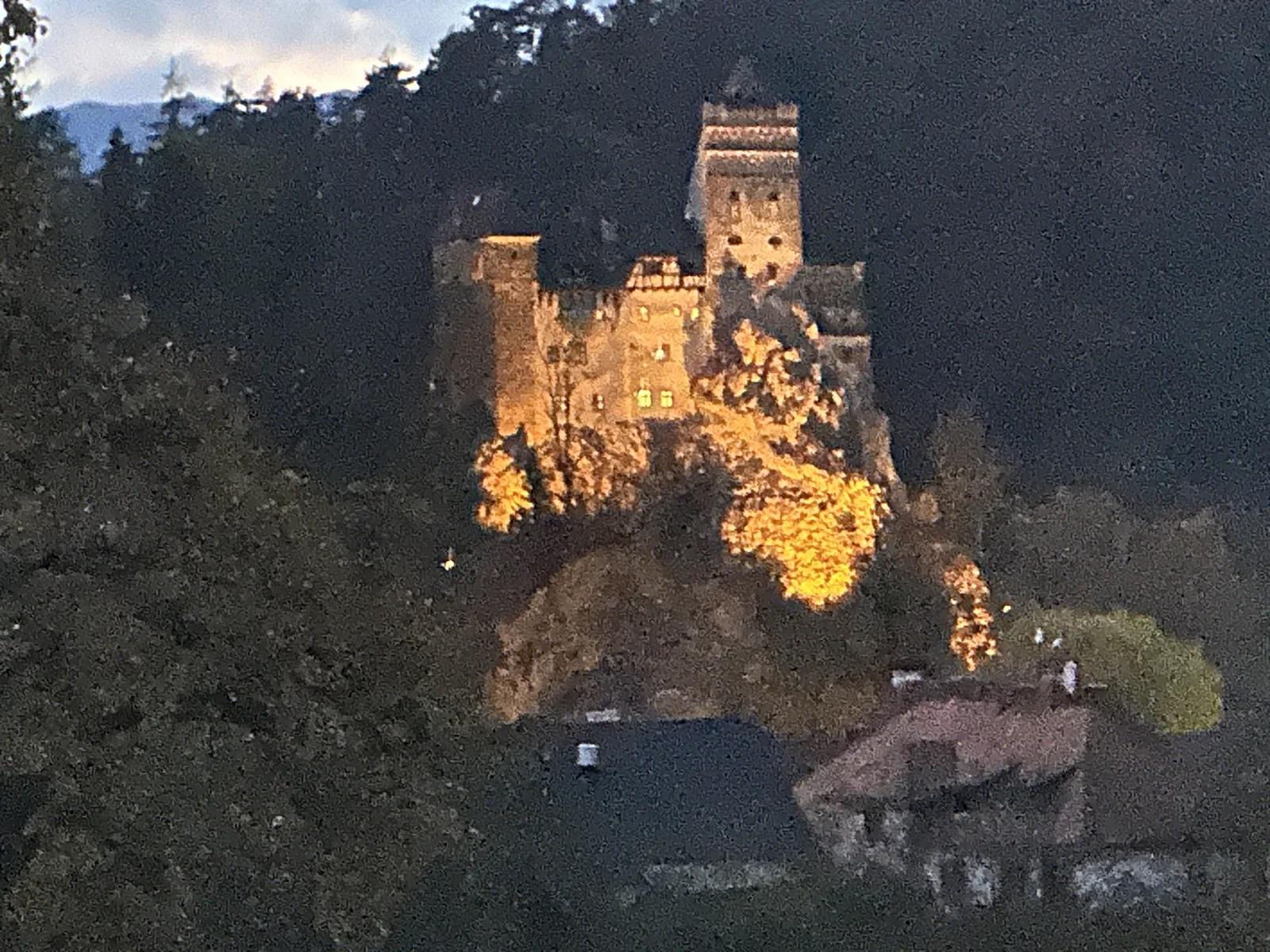
Bran is a historic castle near Brașov and today a museum. It is not named in the novel and is included here for its association with modern Dracula tourism. Bran Castle remains owned by Queen Marie’s heirs, according to the family’s May 2026 statement. It is operated by the Bran Domain Management Company (CADB). In May 2026, Joel Weinshanker’s Ad Populum group was reported to have acquired an 80% controlling stake in that operating company. Weinshanker is also involved in managing Elvis Presley’s Graceland.
Bran Castle illuminated at dusk, with its towers and rocky hillside.Courtesy of the Bram Stoker Estate.