
life
Biography
Abraham “Bram” Stoker (8 November 1847 – 20 April 1912) was a Dublin civil servant, critic, theatre manager and novelist, but he is most remembered today as the author of Dracula (1897). In his own lifetime, he was much better known as Sir Henry Irving’s business manager at the Lyceum Theatre in London, a post he held for 27 years. This role brought him into contact with many leading figures in London’s cultural life.
Meet Bram’s siblings and child for the people behind the public career, including his brothers and sisters and his son Noel.
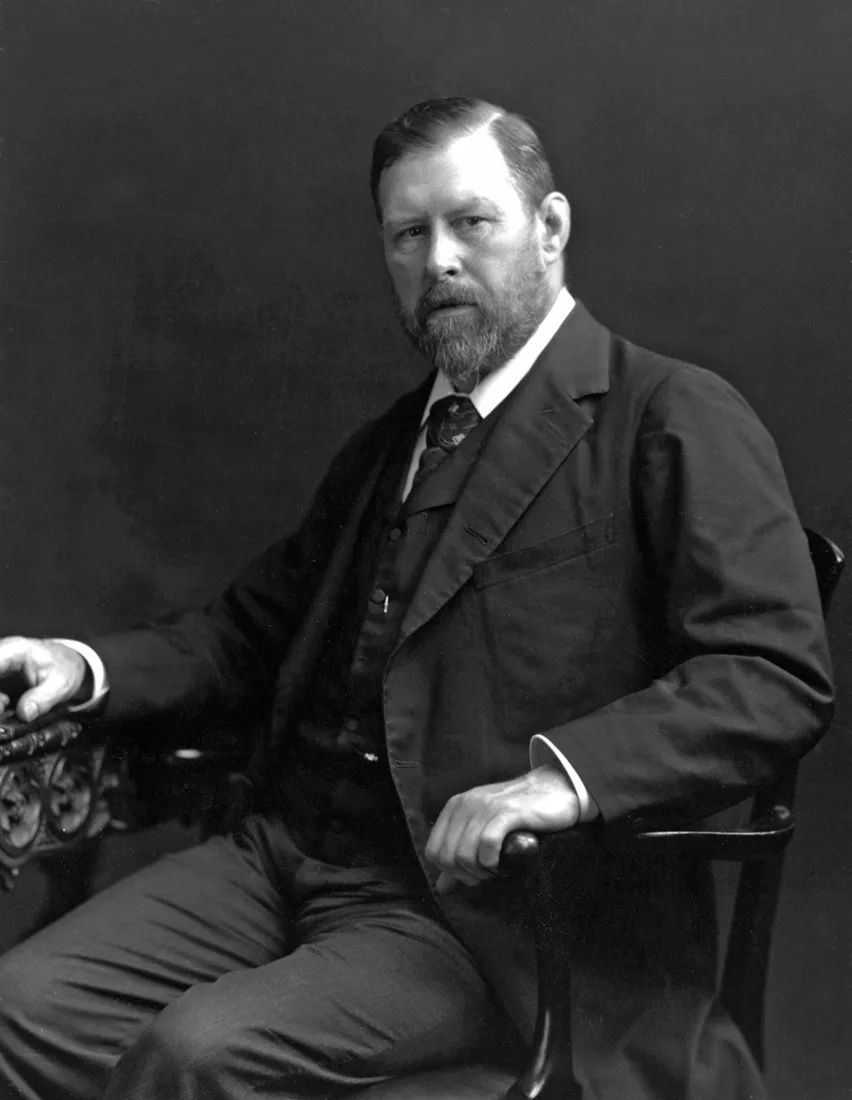
Childhood in Clontarf
Bram was born at 15 Marino Crescent, Clontarf, then a seaside suburb north of Dublin. He was the third of seven children of Abraham Stoker (1799–1876), a civil servant in the Chief Secretary’s Office at Dublin Castle for over fifty years, and Charlotte Matilda Blake Thornley (1818–1901), who was raised in Sligo. The family moved to Killester and Artane Lodge when he was two.
Bram’s childhood was marked by an unexplained illness, said to have kept him bedridden until about seven. He later became a successful athlete. His mother Charlotte’s surviving account of the 1832 cholera epidemic in Sligo offers a striking glimpse of the stories in his family world. Its possible influence on his fiction is explored on the Charlotte Stoker page.
Trinity College Dublin
At Trinity, Bram became known as an athlete and debater. At six feet two inches tall, he was a striking figure. He was named University Athlete, competed in walking races and played rugby for Trinity College. He graduated with a BA in 1870 and received his MA in 1875.
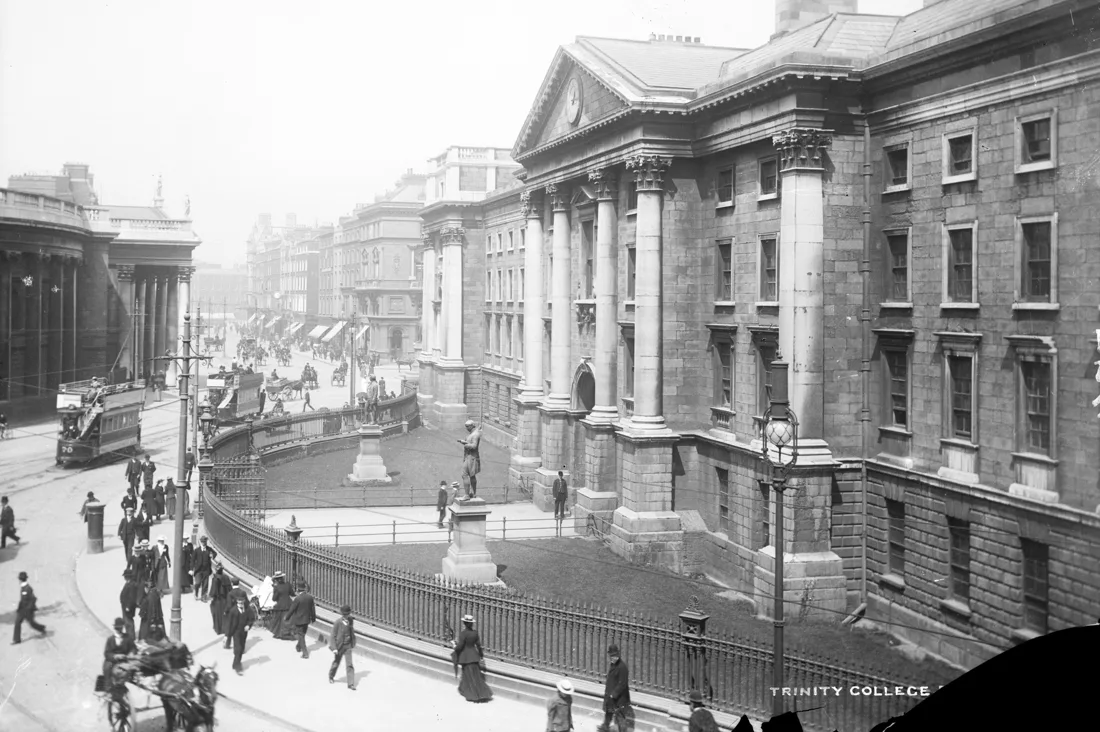
Trinity sources describe him as the only person to have held the top office in both of the college’s leading student societies of his day – Auditor of the College Historical Society, the historic debating union founded in 1770, and President of the University Philosophical Society, its philosophical and literary counterpart.
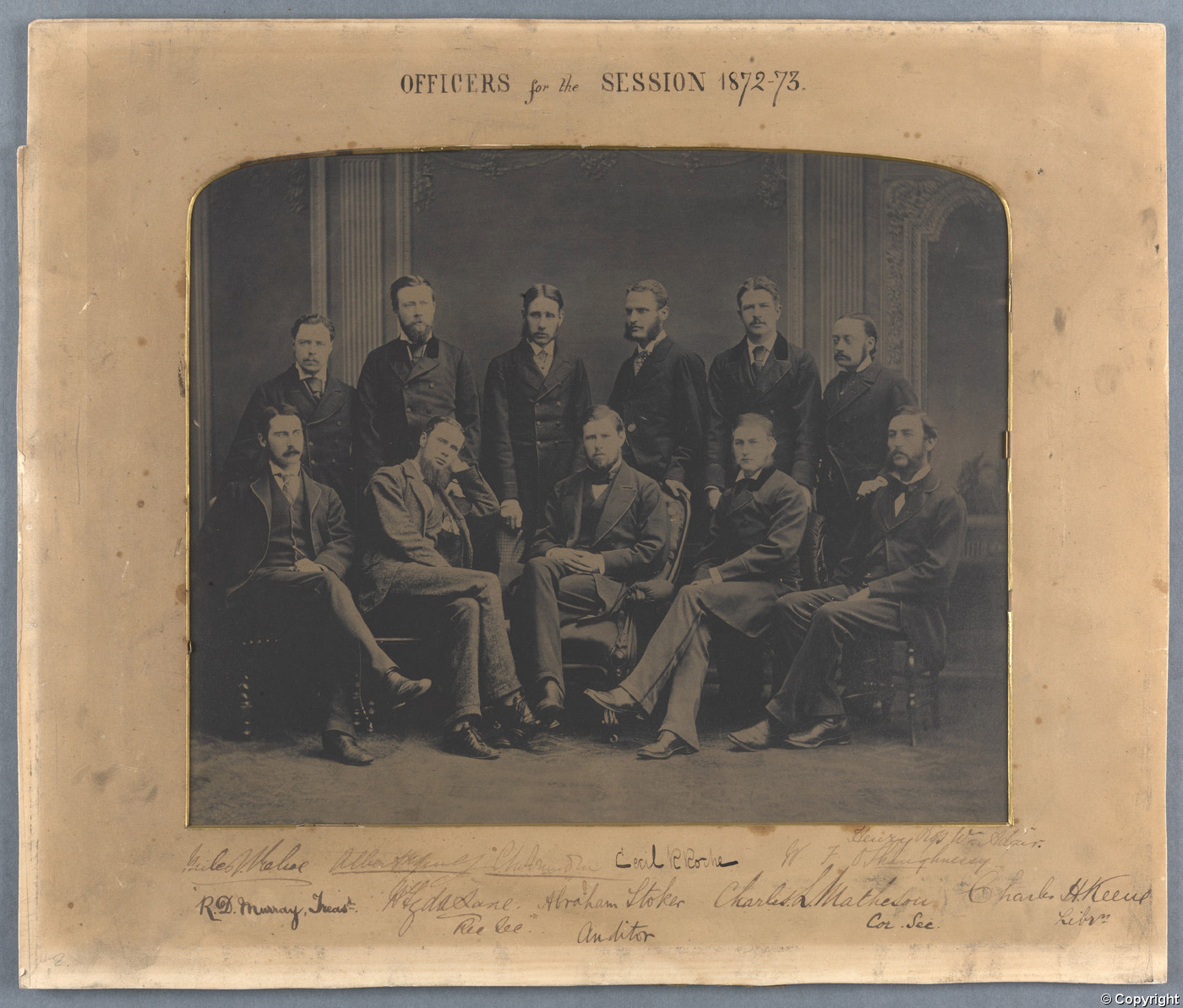
His student interests reached beyond sport. His paper “Sensationalism in Fiction and Society” considered a subject that would remain relevant to his writing; his 1872 inaugural address, “The Necessity for Political Honesty”, addressed public life. These society activities place the future novelist within Dublin’s culture of debate.
Civil servant and critic
Like his father, Bram joined the civil service at Dublin Castle, rising to Inspector of Petty Sessions. His handbook The Duties of Clerks of Petty Sessions in Ireland (1879) became a standard handbook. Alongside official work, he wrote theatre criticism for the Dublin Evening Mail and helped found the Dublin Sketching Club. See Other Works for details of his early serial fiction and books.
He also briefly edited The Irish Echo, a Dublin evening newspaper launched in November 1873. Renamed The Halfpenny Press, it ran into financial difficulties, and Bram left after about four months. His Dublin career therefore included newspaper editing as well as reviewing.
In December 1876 he gave a warm review of Henry Irving’s Hamlet at the Theatre Royal, Dublin. Irving invited him to dinner at the Shelbourne Hotel, and from that very long evening, a lifelong friendship began.
London and the Lyceum
In 1878 Irving took over the Lyceum Theatre in London and asked Bram to be his acting manager. Bram married Florence Anne Lemon Balcombe at St Ann’s Church, Dawson Street, on 4 December 1878, and the couple left for London within days. Their only child, Irving Noel Thornley Stoker, was born on 30 December 1879, with Henry Irving as godfather.
Bram’s work with Irving ranged from accounts and publicity to organising tours and welcoming guests. The Theatre and the Lyceum page tells the story of this demanding working life and the company around him.
Remembered by his son
Noel Thornley Stoker remembered his father as a “red-bearded Giant” who came home in the afternoon, lay at full length on the drawing-room carpet and let his young son climb about his chest. It is an affectionate glimpse of Bram as a father, preserved in Noel’s typescript Bram Stoker, by his Son, Noel Thornley Stoker, preserved in the Stoker family papers at Trinity College Dublin.
The opening refers to Bram’s birth one hundred years earlier, suggesting that the recollection was prepared for the centenary of his birth in November 1947.
A life beyond the theatre and writing desk
In 1882 Bram received a Royal Humane Society bronze medal for a rescue attempt in the Thames. He had jumped from a steamer into the river to help a man who had gone overboard. Attempts to revive the man failed. The episode deserves a place beside his literary achievements, and the medal is one of the objects through which the Estate remembers his life.
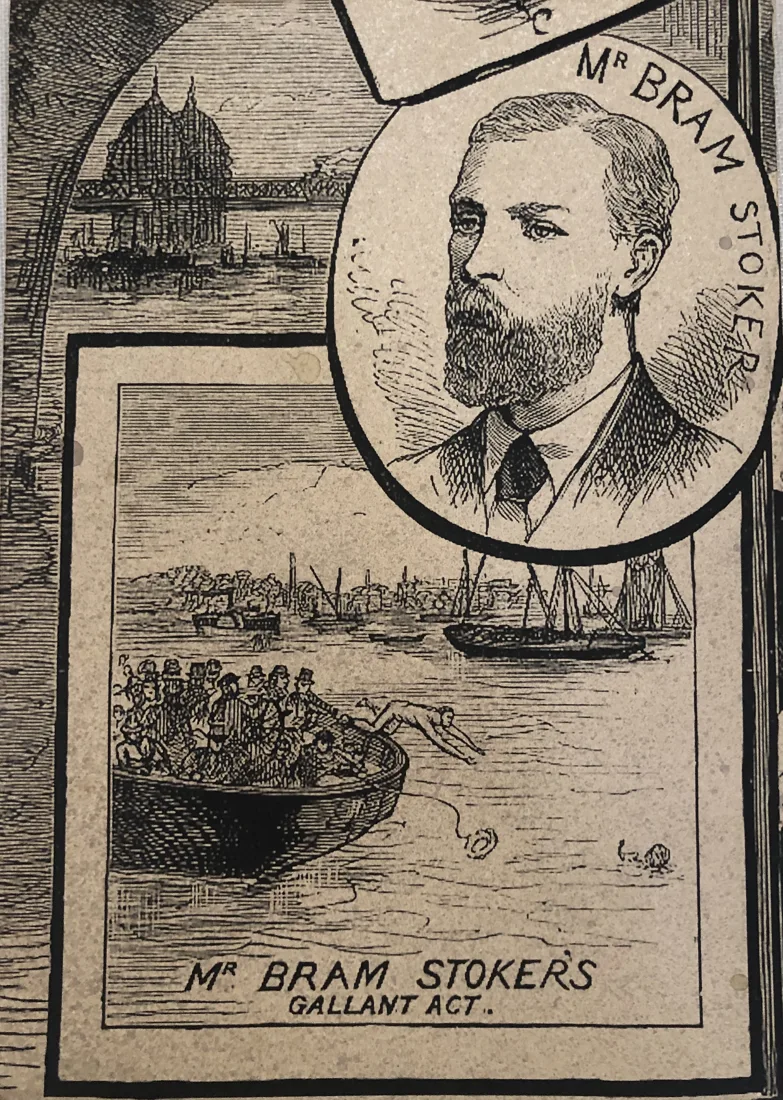
His son Noel Thornley Stoker later recalled the attempted rescue and its aftermath. Read Noel’s account and contemporary newspaper reports and see a photo of the Royal Humane Society medal →
Bram also qualified as a barrister. He was admitted to the Inner Temple in 1886 and called to the English Bar in 1890, although he did not practise. His legal training added another strand to a working life already spanning administration, theatre and writing. The Inner Temple includes him among its notable members.
Writing in the margins
Bram fitted fiction around his theatrical work, writing at home and during holidays. His writing ranged from the early serial The Primrose Path to fairy tales, romances, supernatural stories and the theatrical memoir Personal Reminiscences of Henry Irving. Dracula appeared on 26 May 1897. See Other Works for a guide to what to read, and Dracula for the story of its creation.
Later years
Irving died on tour in Bradford on 13 October 1905. Bram’s Personal Reminiscences of Henry Irving (1906) was widely reviewed. Bram then worked for the Daily Telegraph and briefly managed David Bispham’s light opera The Vicar of Wakefield.
As ill health limited his ability to earn, Bram applied to the Royal Literary Fund for support. In a letter dated 25 February 1911, written from 4 Durham Place, Chelsea, he described his stroke in 1906 and a further breakdown about a year before the letter. He explained that he could not be certain of returning to literary work. The Fund gave him £100; his signed receipt is dated 9 March 1911.
View all three pages of Bram’s letter below → The original is catalogued at the British Library as Loan 96 RLF 1/2841/5; the signed receipt is Loan 96 RLF 1/2841/6.
Bram suffered ongoing health problems in his final years, from a second stroke to pneumonia and Bright’s Disease. He died at the age of 64 at his home, 26 St George’s Square, Pimlico, on 20 April 1912, just days after the Titanic sank. Contemporary notices remembered him in different ways. Some stressed his theatre career; the prominence given to Dracula varied (see Bram’s obituaries in 1912: a reputation already being debated). He was cremated at Golders Green, where his ashes rest in an urn, later joined by those of his son Noel.
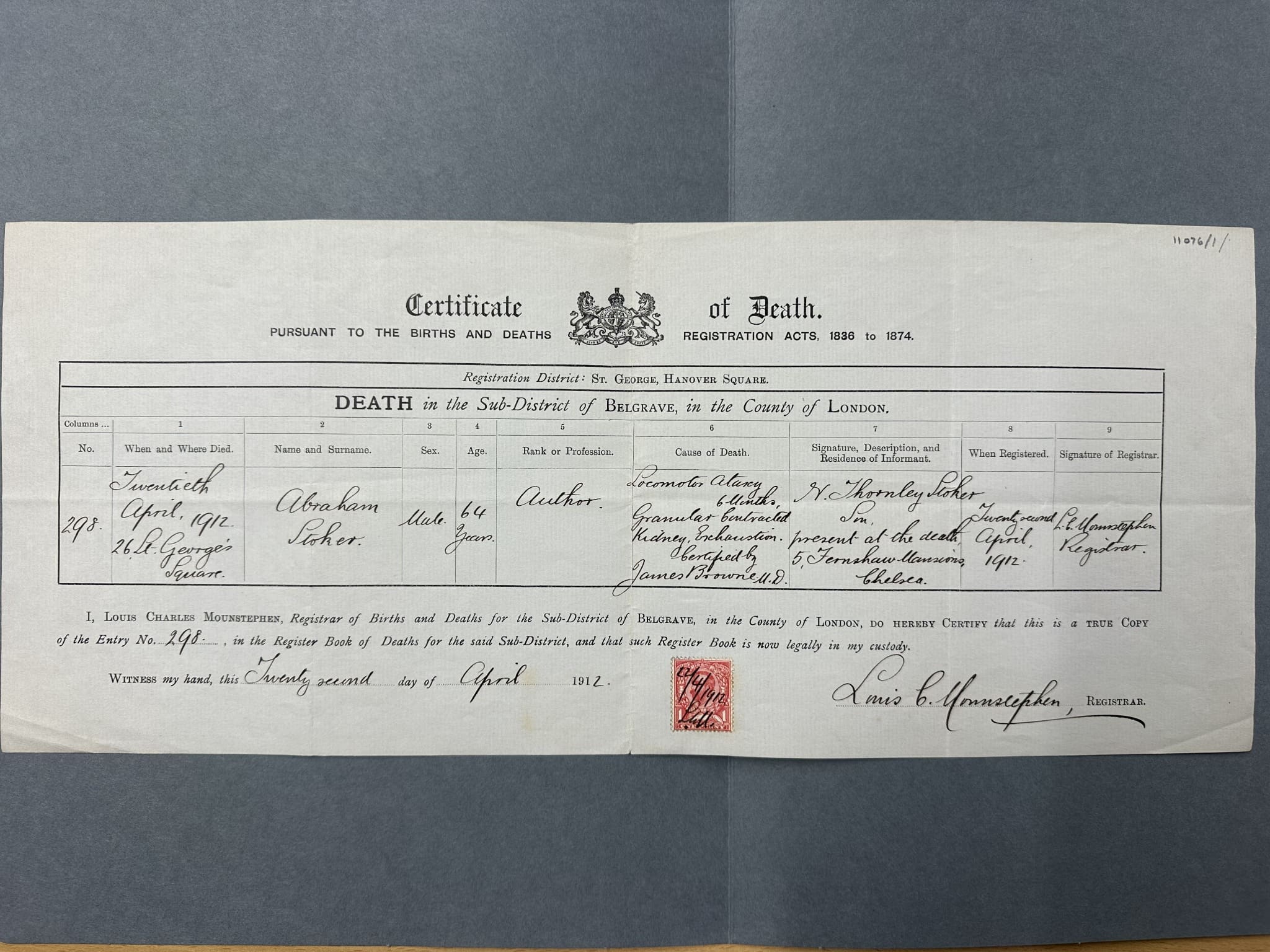
The certificate records Abraham Stoker’s death at 26 St George’s Square on 20 April 1912, aged 64, and gives his profession as “Author”. His son, I. N. Thornley Stoker, is named as the informant and as present at the death. Select the image to examine it at full size.
The medical wording on Bram’s death certificate has prompted differing interpretations among biographers. The Estate presents the historical record without drawing a medical conclusion.
Bram’s letter to the Royal Literary Fund
The three written pages of Bram’s letter of 25 February 1911 are reproduced below. Select either image to read it at full size.
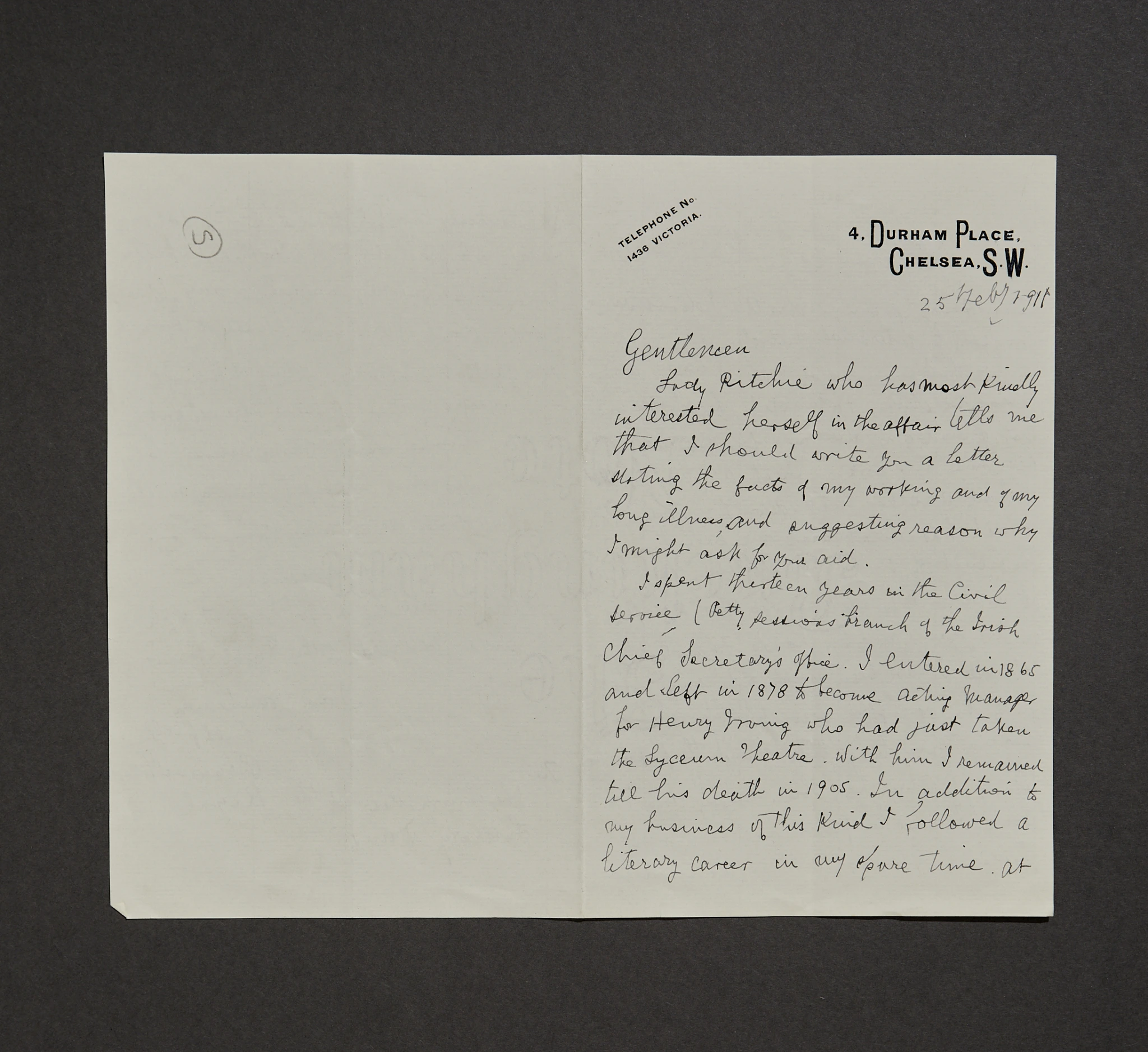
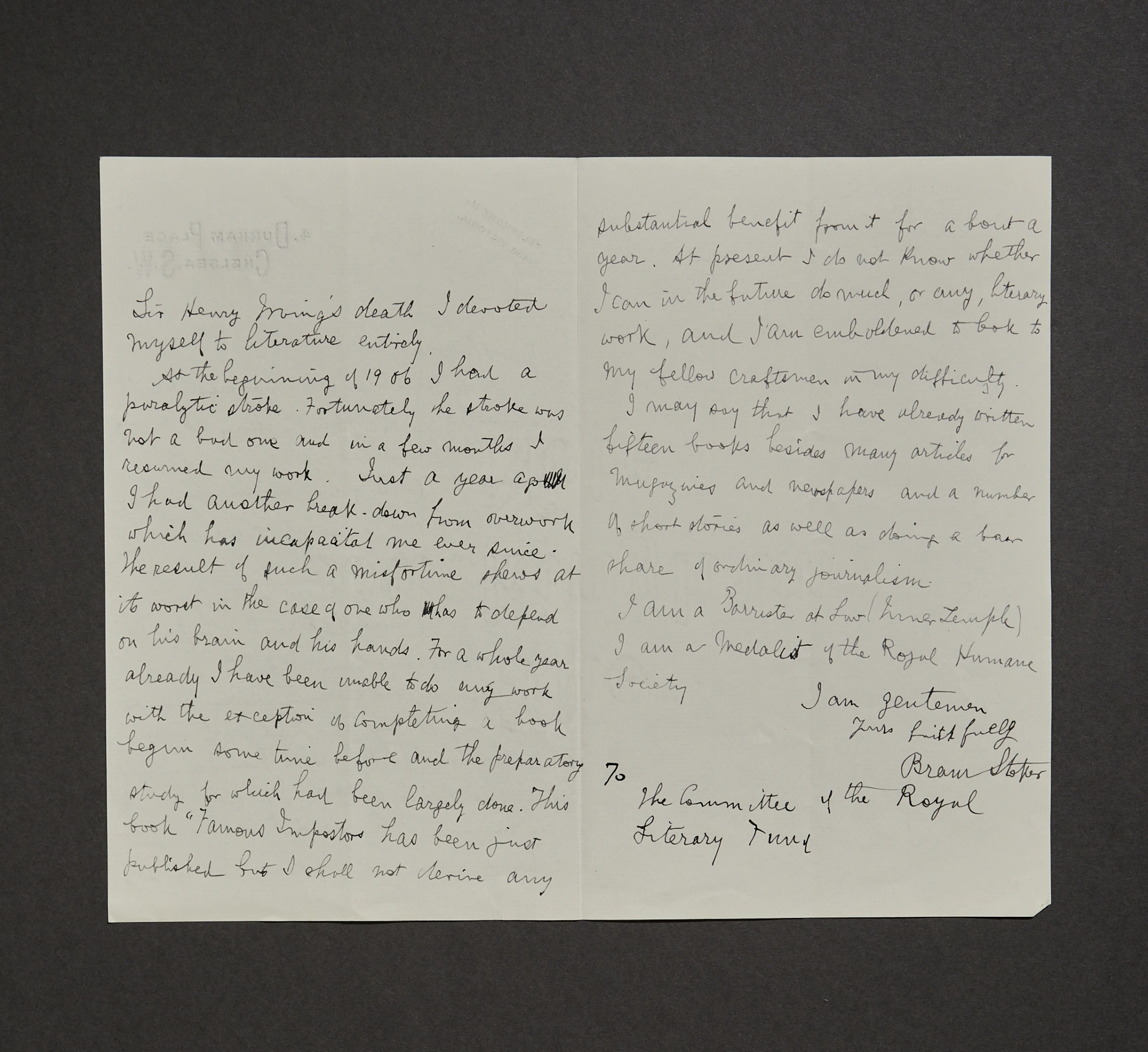
Original letter: British Library, Loan 96 RLF 1/2841/5. Images reproduced on the Royal Literary Fund archive page.
Bram’s obituaries in 1912: a reputation already being debated
Obituaries published after Bram’s death varied in the attention they gave to Dracula. The Globe and Westminster Gazette omitted the novel, remembering his work with Henry Irving. The Times mentioned it briefly, but expected his memoirs of Irving to be his lasting literary memorial.
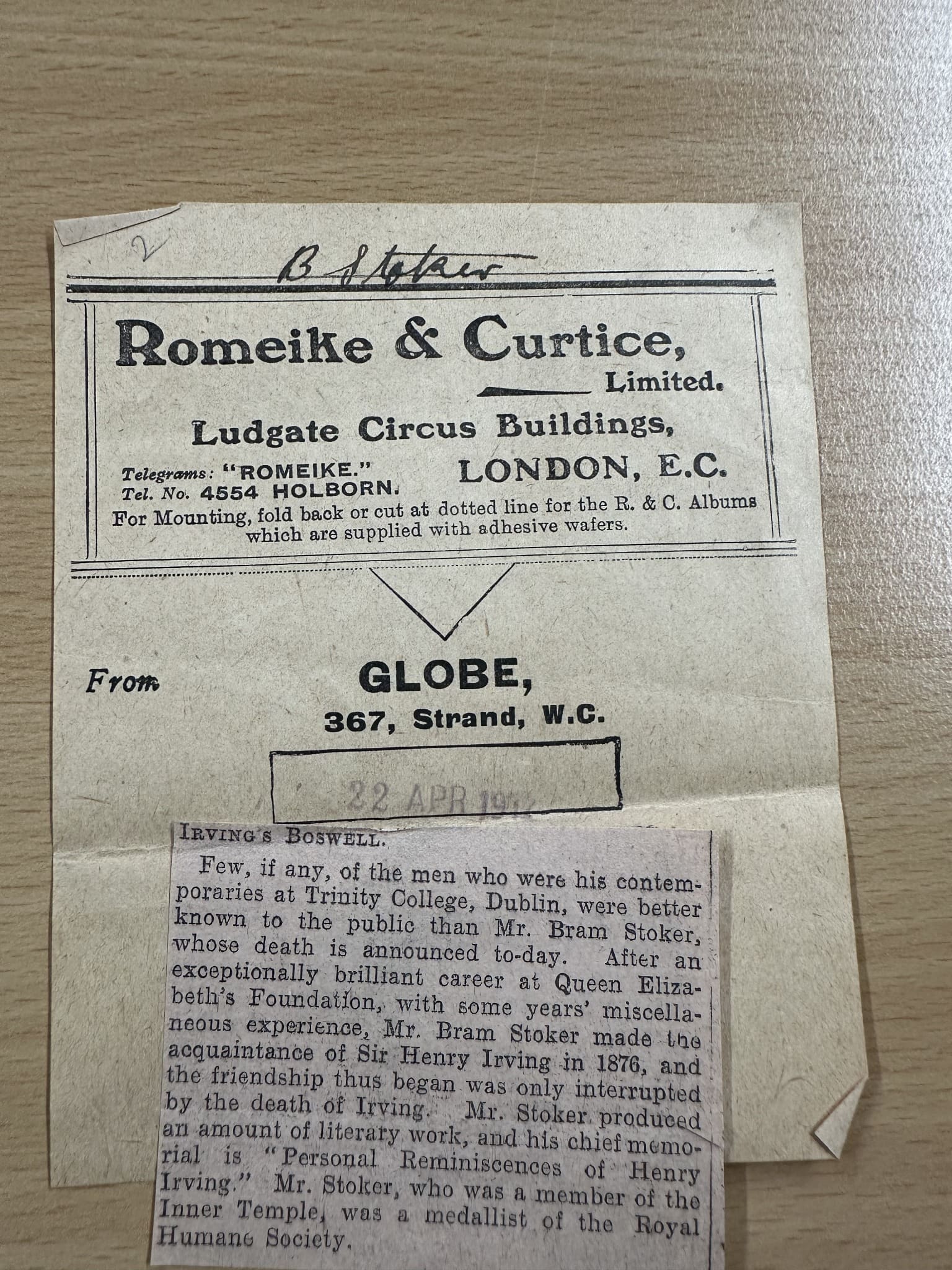
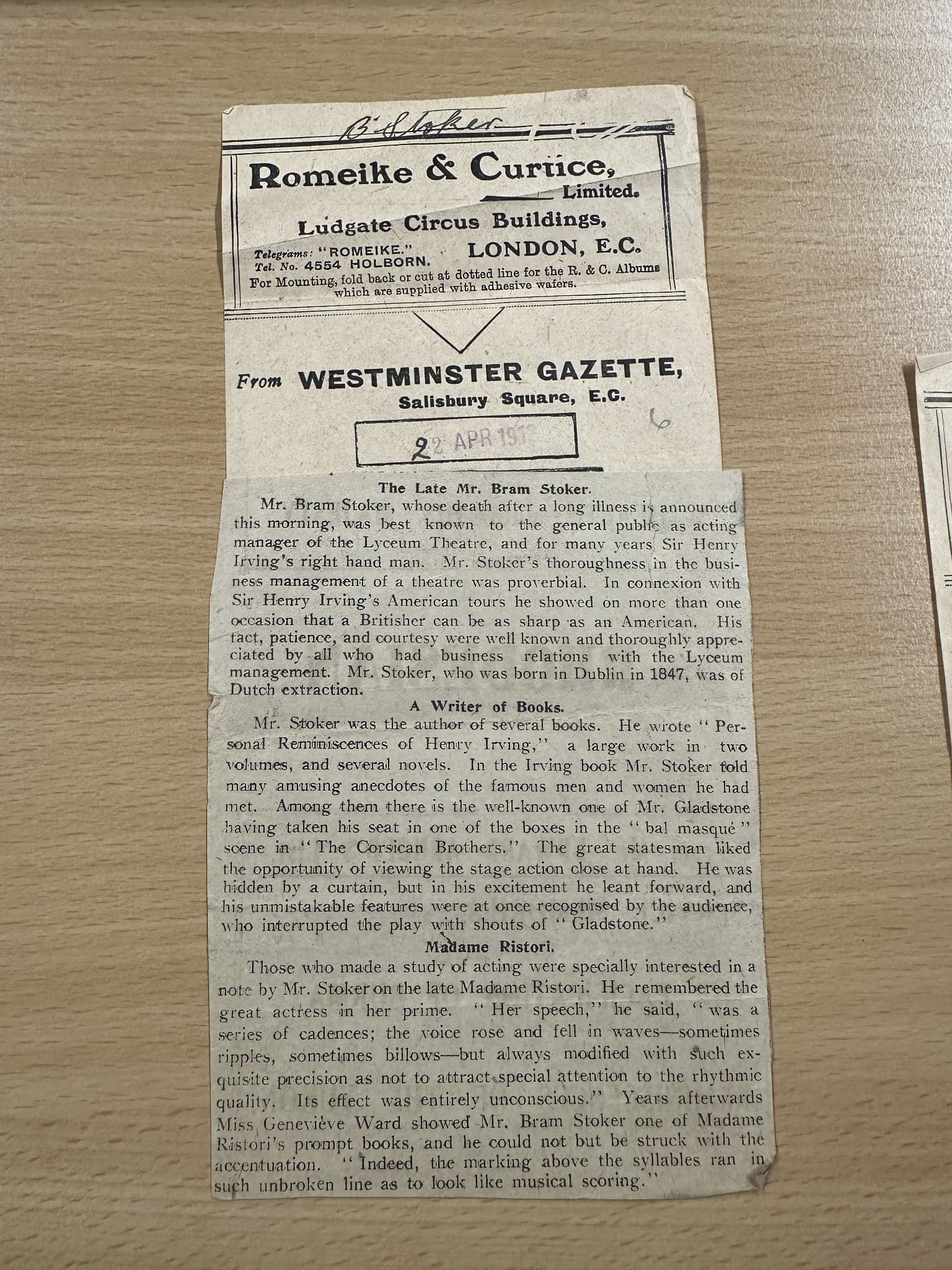
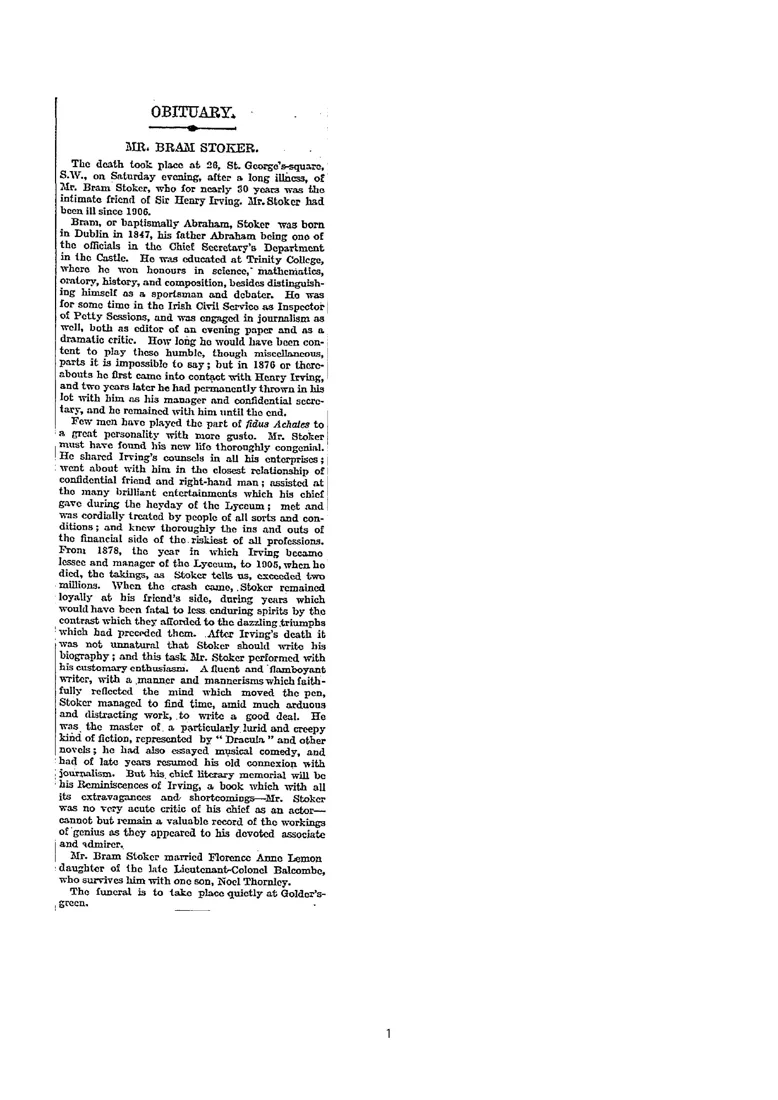
Other writers recognised the novel’s significance: a 1912 notice in The Literary World identified Dracula as the book that had made Bram famous, and Clement Shorter predicted that it would endure alongside Frankenstein.
Explore the full collection of obituaries and contemporary tributes →
Florence Stoker and the afterlife of Dracula
After Bram’s death, Florence Stoker became the steward of his literary work. Her publication of Dracula’s Guest and Other Weird Stories, licensing of the stage adaptation and action over Nosferatu helped shape the story’s later life.
Further sources
For Bram’s legal qualification, see the Inner Temple’s list of notable members and the Dictionary of Irish Biography. His life and newspaper editing are discussed by Jarlath Killeen, Professor in Victorian English at Trinity College Dublin, and in William Hughes’s research-guide introduction, dated December 1996.