
Work
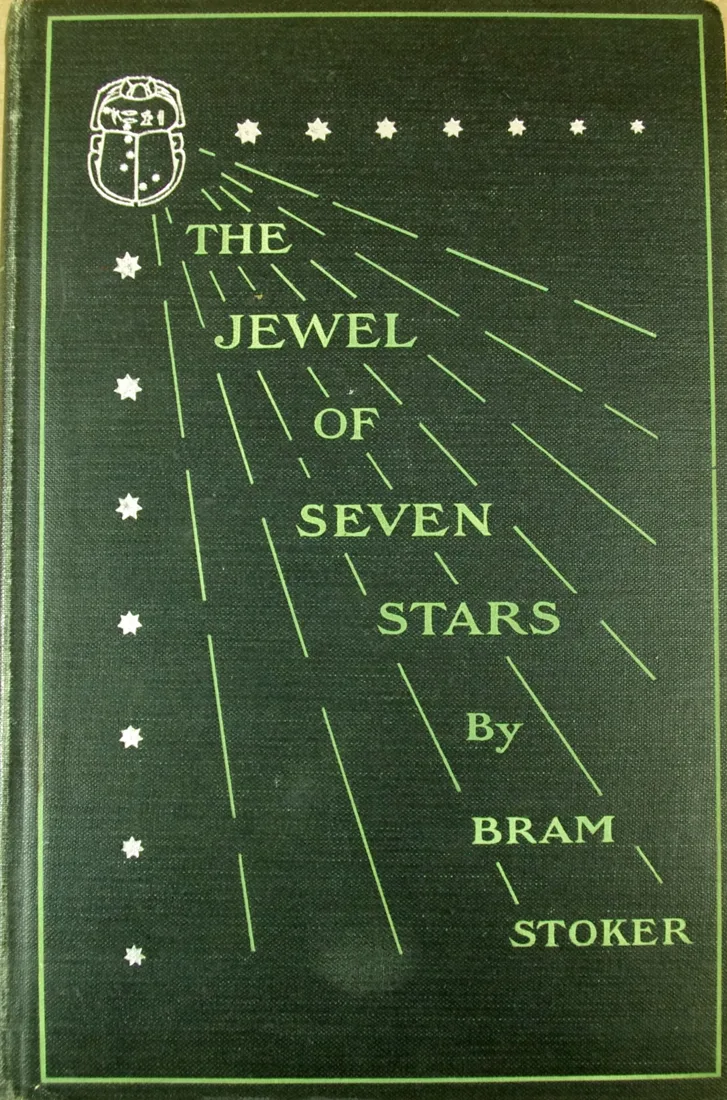
The Jewel of Seven Stars
An Egyptologist’s London house becomes the setting for a dangerous attempt to recover ancient knowledge—and for a novel whose ending changed between editions.
Publication: 1903; revised text 1912.
A summons in the night
The barrister Malcolm Ross is summoned to the home of Margaret Trelawny. Her father, an Egyptologist, has been found unconscious in a room filled with antiquities. Unexplained injuries, carefully prepared instructions and the remains of Queen Tera draw the watchers towards an experiment whose purpose gradually becomes clear.
Ross tells the story in the first person. Police and medical inquiry share the page with accounts of excavation, ancient beliefs and speculation about forces that modern science has yet to understand.
From watching to experimenting
The opening chapters ask readers to examine a puzzling room, its objects and the behaviour of those who guard it. Later accounts widen the setting to Egypt and the history of the tomb. The action then moves towards the Great Experiment. Knowledge arrives through several voices, although Ross remains the person arranging what we hear.
What to look for
Ask who is entitled to interpret Queen Tera’s intentions. Consider the difference between treating the dead queen as a specimen, a source of useful knowledge and a person with wishes of her own. Margaret’s relationship to Tera makes these questions personal as well as archaeological.
The novel’s scientific language is part of its imaginative world. Eleanor Dobson’s study of Stoker and H. Rider Haggard examines the relationship between ancient Egypt, electrical spectacle and X-rays, offering useful context for the apparatus and light surrounding the experiment.
Reading objects and voices
At first, the reader shares the watchers’ restricted view of Trelawny’s room. An object that looks like a clue may belong to a system of knowledge that the narrator does not yet understand. Notice when an explanation comes from a doctor, a policeman, an excavator or Trelawny himself, and ask what experience each speaker brings.
For a comparison of the two versions, first read one ending without interruption. Then return to the omitted chapter and the alternative conclusion. Ask which uncertainties the ending resolves and which it leaves open. A claim about the novel’s final judgement needs to identify the version on which it rests.
Two versions: check which one you are reading
The novel was first published by William Heinemann in 1903; Harper & Brothers issued the first American edition in 1904. A revised edition appeared with William Rider in 1912. It omitted the chapter “Powers—Old and New” and changed the conclusion. These are significant differences, not merely changes in spelling or punctuation.
The free Gutenberg edition linked here has nineteen chapters and follows the revised text. For comparison, choose an edition that explicitly includes the original conclusion and the revision. The version matters when discussing what the experiment achieves or how the novel treats Margaret and Tera. This guide does not reveal either ending.
Read the book
The free reading text below contains the revised nineteen-chapter version. For comparison, choose an edition that explicitly includes both conclusions. William Hughes’s bibliography identifies David Glover’s Oxford edition (1996) and Clive Leatherdale’s annotated edition (1996) as providing both.