resources
Bram’s obituaries in 1912: a reputation already being debated
When Bram died in April 1912, newspaper notices offered strikingly different judgments of his life and work. Some overlooked Dracula; others recognised the novel’s importance. Read together, they show a reputation already being debated.
The notices that omitted Dracula
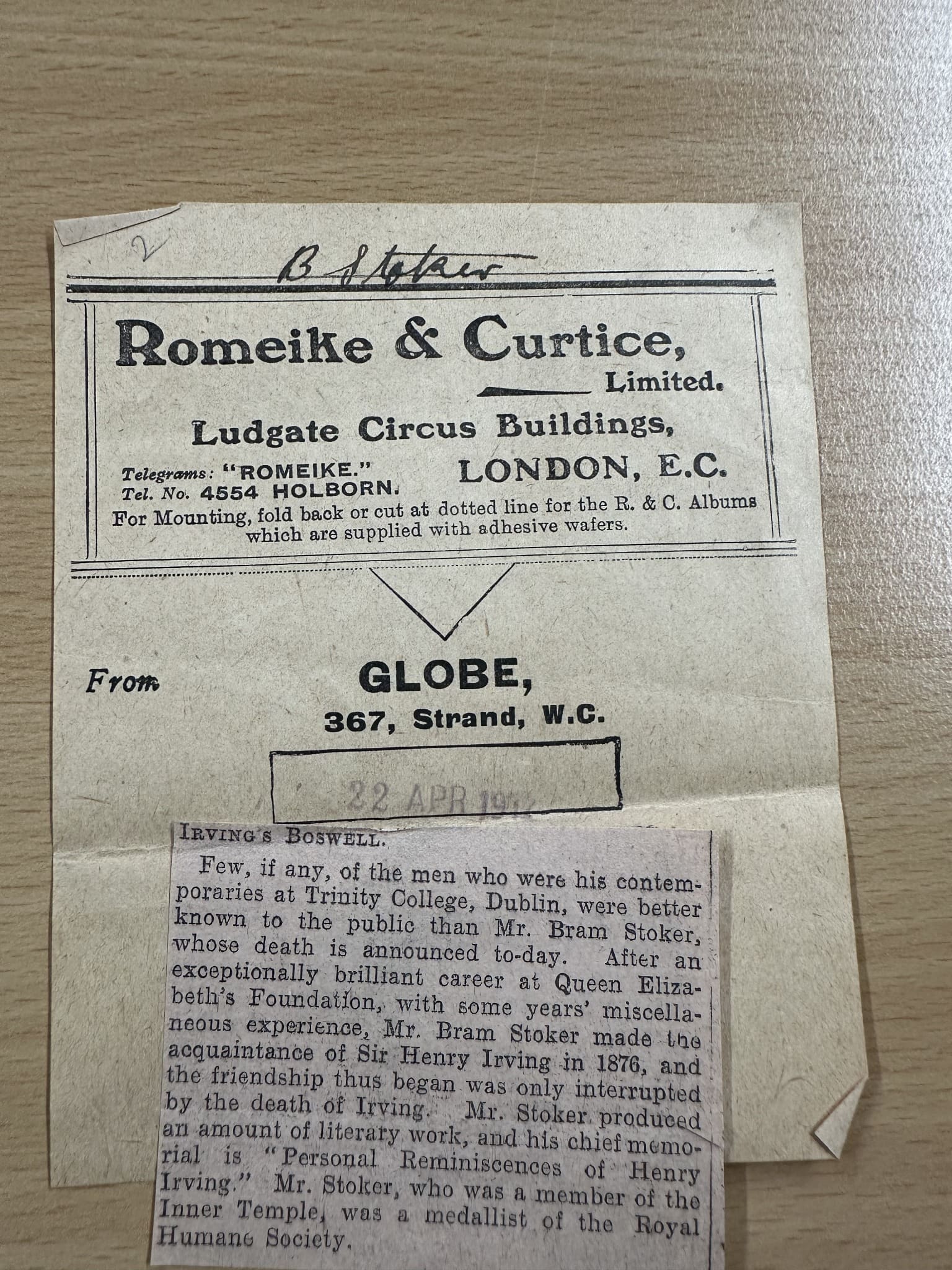
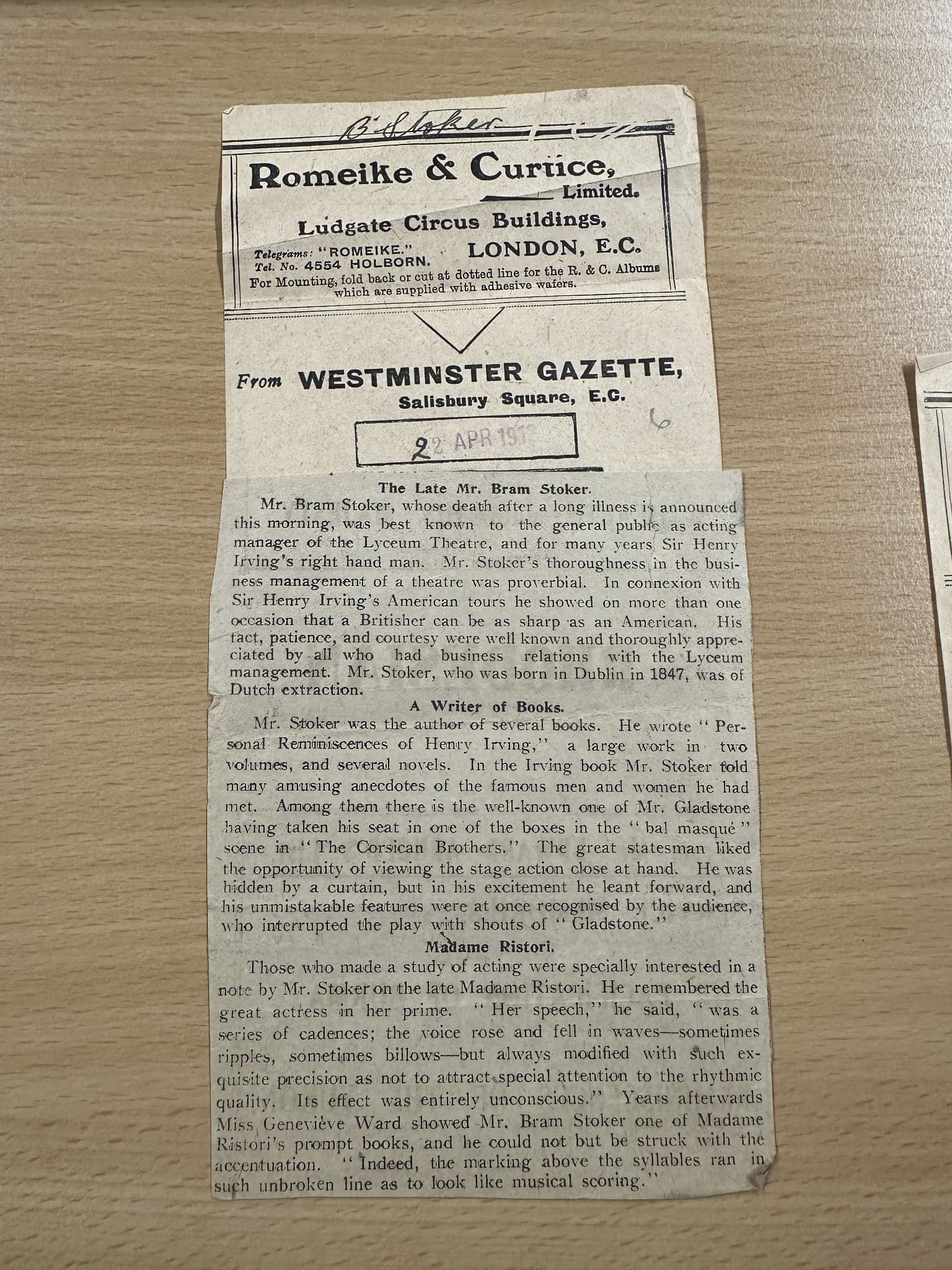
The Globe notice headed “Irving’s Boswell” presents Bram chiefly through his friendship with Henry Irving and calls Personal Reminiscences of Henry Irving his chief memorial. The Westminster Gazette praises his theatre management, tact, patience and courtesy. Neither of the two surviving clippings supplied from the family archive names Dracula.
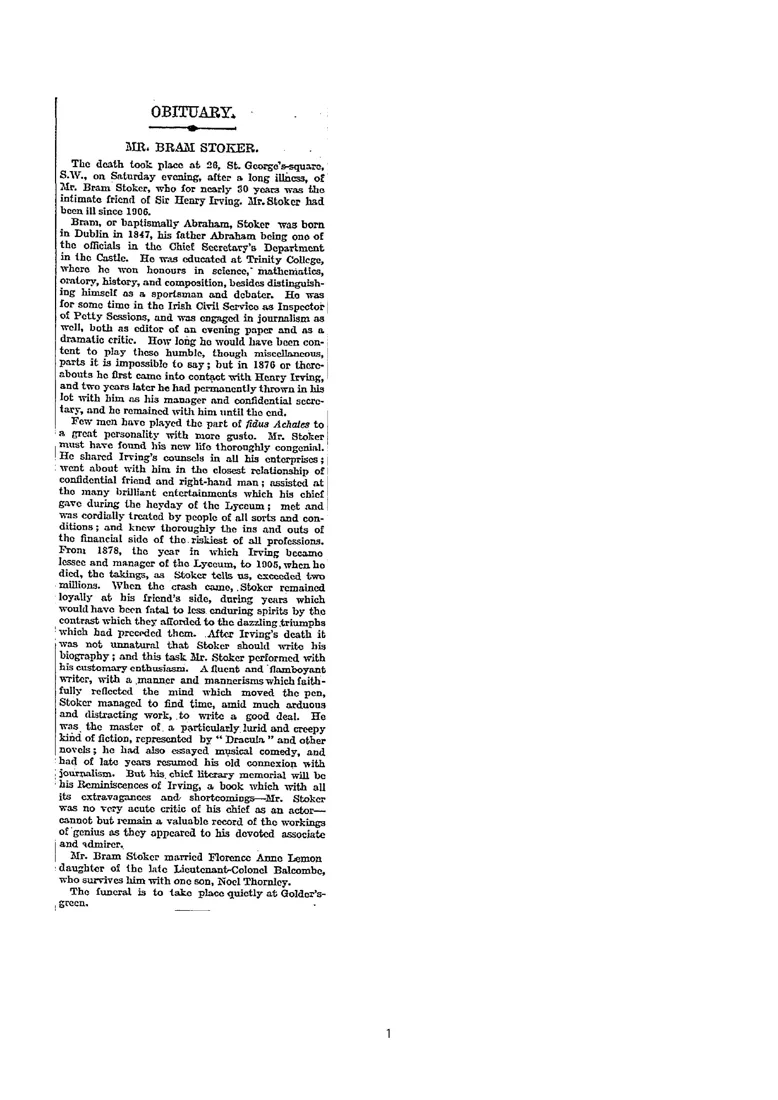
The Irish Times obituary of 23 April 1912 likewise omits the novel in the text republished for the centenary. It gives particular attention to Trinity College, Dublin, and his career with Irving, judging his biography more highly than his fiction. Read the Irish Times archive reprint ↗
A reputation seen through Irving
The Times obituary of 22 April 1912 does mention Dracula, but treats it as an example of Bram’s lurid and unsettling fiction. Its prediction of his lasting literary achievement rests instead on his memoirs of Irving.
The New York Times notice of 23 April lists Dracula among his novels while identifying the Irving memoir as his best-known publication. Source: Estate archives.
Those who saw Dracula’s future
A 1912 notice headed “The Late Mr. ‘Bram’ Stoker”, attributed in the Estate archives to The Literary World, “British Books”, takes a different view: it identifies Dracula as the work through which Bram had achieved fame. Source: Estate archives.
Clement Shorter went further. In a tribute in The Sphere of 4 May 1912, quoted in the New Zealand Times on 6 July, he challenged the view that the Irving memoir was Bram’s most important work and predicted that Dracula would endure alongside Frankenstein. The New Zealand literary columnist “Liber” enthusiastically agreed. Read “A Literary Corner” in Papers Past ↗.
Reading the notices today
These are contrasting contemporary judgments, rather than a single verdict on Bram’s reputation. The omissions are revealing, but so are the writers who already recognised the strength of Dracula. His work in the theatre, his friendships and his fiction all belong to the story.
The notices also contain biographical errors. They are presented as evidence of how Bram was remembered, rather than as unquestioned authorities for every detail of his life.
The original document
The Times, 22 April 1912, page 15, “Mr. Bram Stoker”. Read alongside Biography and Theatre and the Lyceum for the wider story.
Sources and further reading
Globe and Westminster Gazette: family-supplied photographs of Romeike & Curtice press clippings; the date stamps appear to read 22 April 1912. The Irish Times: 23 April 1912, republished 23 April 2012. The New York Times: 23 April 1912, transcription. Source: Estate archives.
The Literary World, “British Books”, volume 96 (1912): Source: Estate archives; exact issue date remains to be established. Clement Shorter, The Sphere, 4 May 1912: passage reproduced in “A Literary Corner”, by “Liber”, New Zealand Times, 6 July 1912, page 10. The Shorter passage has been read through that contemporary reprint.
Further notices to explore
Further contemporary notices include “Death of Mr Bram Stoker. Sir H. Irving’s Manager”, Daily Telegraph, 22 April 1912, page 6; Hall Caine’s personal tribute “Bram Stoker. The Story of a Great Friendship”, Daily Telegraph, 24 April 1912, page 16; and an obituary in The Stage, 25 April 1912, page 15. These references have been located, but their complete texts have not yet been checked for this collection.
Bibliographic references for the Telegraph notices ↗ · Find The Stage notice in the British Newspaper Archive ↗
The 1912 obituaries
The newspaper notices are reproduced as historical sources and contain errors. Bram was born in 1847, his wife was Florence Anne Lemon Balcombe, and Personal Reminiscences of Henry Irving appeared in 1906. These corrections do not silently alter the original newspaper wording.
Historical material from the Bram Stoker Estate records. Original wording is retained in quoted sources.
The Literary World, “British Books”, Vol 96, Publisher’s Circular Ltd 1912 The Late Mr. “Bram” Stoker
Mr. “Bram” Stoker as he was familiarly called, though his Christian name was Abraham, died on April 20th, in London, in his 65th year, after a long illness. Civil servant, journalist, novelist, author, and private secretary to the late Sir Henry Irving, Mr. Stoker led always a busy life, pursuing more than one calling at once. His most imposing literary work is his “Personal Reminiscences of Henry Irving,” published five years ago; but the work by which he has achieved fame is undoubtedly that remarkable book of fiction, in the shape of letters, entitled “Dracula,” a vampire story, that has passed through numerous editions. Mr. Stoker’s latest book, “The Lair of the White Worm,” which appeared at Christmas somewhat after the same model, but it exhibited signs of the breakdown in his health, which has now had a fatal termination. Its predecessor, “The Lady of the Shroud,” was a charming mystery story of the Balkans; and an earlier one, “Lady Athlyne,” was a clever romance, based on the Scotch marriage law. Although not in the front rank of novelists, Mr. Stoker was a. great favourite with novel readers, and could be depended upon to supply interest and sensation, coupled with literary style.
[“Bram” Stoker was a most genial, charming man; a shilling edition of his “Dracula” has only just been published – ED. P.C. ]
Bram Stoker Dead at 64 Author, and Manager of Sir Henry Irving, Expired in London.
Bram Stoker, author, theatrical manager, close friend and advisor of the late Sir Henry Irving, died in London last Sunday. For twenty-seven years he was business manager for the famous English actor, in charge of the Lyceum Theatre during Irving’s tenancy of that house.
Mr. Stoker, whose first name was Abraham and who was always known by the diminutive of Bram, was born in Dublin in 1848. His father held an official post in Dublin Castle, and the young man was educated at Dublin university. At the university he took high honors in mathematics, and after his graduation he obtained a post in the civil service, finally becoming an Inspector of Petty Sessions.
His personal relationship with Sir Henry Irving began in early youth, and their business association was formed in 1878, when Irving began his carer at the Lyceum. This association was not ended until the death of the actor, in 1905. After the passing of Irving, Stoker served on the literary staff of the London Daily Telegraph, and also acted as the manager of David Bispham’s light opera, “The Vicar of Wakefield.”
His best-known publication is “Personal Reminiscences of Henry Irving,” issued in 1908. Among his other works, mostly fantastic fiction, are “Under the Sunset,” “The Snake’s Pass,” “The Watter’s Mou,” “The Shoulder of Shasta,” “Dracula,” “The Mystery of the Sea,” “The Jewel of the Seven Stars,” and “The Lady of the Shroud.”
His wife was Florence Agnes Lemon Balcombe, and they had one son. He was a medalist of the Royal Humane Society and a member of the National Liberal, the Authors’, and the Green Room Clubs.
The New York Times April 23, 1912
Note: copied with original errors. Corrections: Born in 1847, Florence Anne Lemon Balcombe
Bram Stoker 1847 – 1912
In the early seventies there was no more popular man in Trinity College. As an athletic he was facile princeps, being one of the finest walkers who ever won the championship. His attainments in science gained him honours in pure mathematics, but his fame was made not in the Examination Hall, but in the Undergraduate Debating Societies.
He was Auditor of the College Historical and President of the Philosophical Societies, a double distinction which it is reserved for few to obtain. The exuberance of his spirits, the friendliness of his manner, and his firm, straight- forward character gained for him a welcome wherever he went. Mr. Stoker was born in Dublin on the8th of March, 1847. His father, Mr. Abraham Stoker, was an official in the Chief Secretary’s Office, Dublin Castle, which position he held for over fifty years. He married the daughter of Captain Thomas Thornley, of Ballyshannon, and they had a large family of sons.
Bram was appointed to the office of Registrar of Petty Sessions Clerks in Dublin Castle, where he remained until 1878. During this period he took the M.A. degree in the University of Dublin, and, having also gone through the Law School, he was called to the English Bar.
Mr. Stoker’s literary ability was shown at an early age, and while still a college student, in addition to his office work, he found time to act as dramatic, art, and literary critic for several journals both in England and Ireland.
It was at a supper party given in the rooms of that Mr. Stoker first made Sir Henry Irving’s acquaintance, which resulted in his becoming manager and confidential secretary to Irving, then lessee of the Lyceum.
Many of his friends in Dublin thought at the time that it was hardly wise on his part to give up the certainty of a Government position and to commence life afresh in the hazardous theatrical profession. Events proved the risk was worth taking, and he remained with Sir Henry Irving until the great actor’s death in October 1905.
Since then, his attention was more fully directed to literary work. He was on the staff of the Daily Telegraph, and has written several novels, mostly of a sensational character. In 1906 he brought out his Life of Henry Irving, which was one of the books of the year, and financially and in every other respect proved a huge success. As a biographer dealing with the life of a man he knew so intimately, he did better work than as a novelist. There was a demand for his books, however, and from 1882, when he published Under the Sunset, until 1905, when he wrote The Man, he brought out eight tales, which were readable, though they were not marked by any originality. Before attempting fiction he published a valuable work on The Duties of Clerks of Petty Sessions in Ireland, which is a standard authority on the subject.
Originally published 23 April 1912, this obituary was reprinted in the “Irish Times” on 23 April 2012 to mark the Centenary of Bram Stoker’s death.