
resources
Bram in person
A working voice
Bram’s public work left many traces: letters, programmes, reviews and a memoir of the theatre. Read together, they reveal someone whose life depended on practical arrangements and close attention to other people.
In Personal Reminiscences of Henry Irving, Bram described an immense correspondence undertaken in the actor’s name. It was one of the less visible tasks that sustained Irving’s public career. Read Theatre and the Lyceum for the working day behind the performances.
Two interviews show Bram on opposite sides of the conversation: answering Jane Stoddard’s questions about Dracula in 1897 and interviewing Arthur Conan Doyle in 1907.
Remembered by his son
Noel Thornley Stoker remembered his father as a “red-bearded Giant” who came home in the afternoon, lay at full length on the drawing-room carpet and let his young son climb about his chest. It is an affectionate glimpse of Bram as a father, preserved in Noel’s typescript Bram Stoker, by his Son, Noel Thornley Stoker.
The opening refers to Bram’s birth one hundred years earlier, suggesting that the recollection was prepared for his centenary in November 1947; the typescript’s date has not yet been independently confirmed.
A father backstage
A small episode in the same memoir gives a different view. Bram took his young son Noel to Irving’s dressing-room during Faust, where the actor transformed the boy with a few strokes of make-up. The family page tells the story in full.
Remembering a person
Recollections can bring a historical person close, but they are not interchangeable. A contemporary memoir, a later family memory and a biographer’s interpretation each tells us something different. The Estate’s stories identify those distinctions and welcome new evidence.
Anecdotes letters and cuttings
Historical material from the Bram Stoker Estate records. Original wording is retained in quoted sources.
Bram Stoker, Himself
A Collection By and About Bram Stoker
“I myself am of an old family” – Count Dracula (1897)
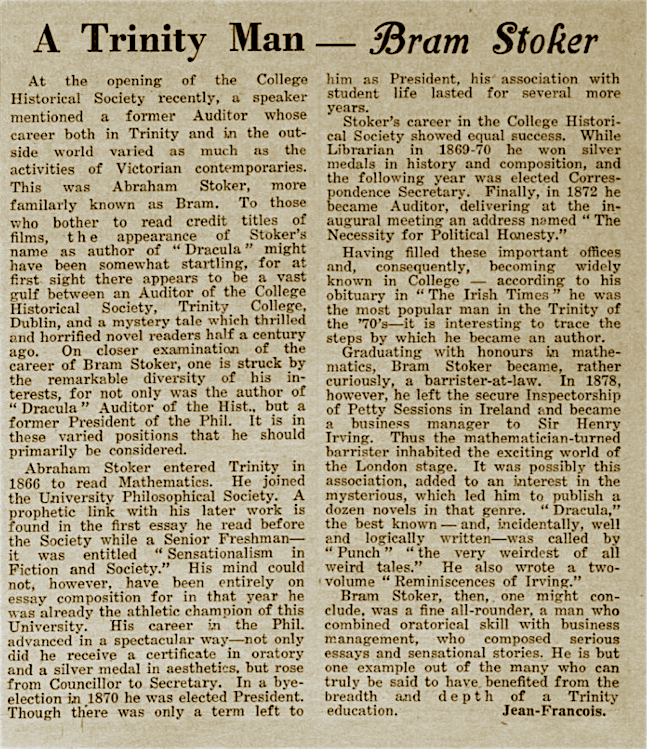

FREEMAN’S JOURNAL June 1, 1866 GRAND WALKING MATCH – Yesterday, a grand walking match came off in the park of Trinity College for prizes consisting of a silver cup, an electro-plated cup and a “pewter.” The distance to be gone over was seven miles, and the start took place at five minutes to three o’clock in extremely wet weather. Mr. A. Stoker came in winner in an hour and eight minutes. Mr. F. Smith came in second, and Mr. Hart third. There were twelve gentlemen entered for the race, and eight started.
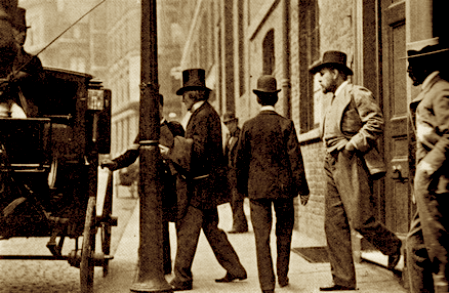
Bram Stoker follows Sir Henry Irving into the waiting cab outside the Lyceum Theatre
Henry Irving and Bram Stoker: A Working Relationship by Michael Kilgariff Posted on the Irving Society website
Trinity News A Dublin University Weekly Vol. VI – No. 4 Thursday, 20th November 1958 Price 3d.
The Houston Daily Post
Houston, Texas : 6 March 1897 Points about People
Bram Stoker, who stands in Henry Irving’s place to the outside world, has accompanied him on all his trips to this country. He is an athletic man, with pointed blonde beard and the shoulders of a college oarsman. He is an Oxford graduate, and a man particularly adapted to the various duties which he is called as Irving’s personal representative.
(Correction by BSE, Bram Stoker graduated from Trinity College Dublin.)
Bram Stoker, who accompanied Henry Irving to this country, writing of American homes, says that every man builds his own house according to his own wants, the consequence being a general picturesque effect, and the creation of almost a new order of architecture. He particularly mentions Michigan Avenue, Chicago, as a street of great beauty.
The Current, Edgar L. Wakeman 1886

A series of sketches attributed to Bram Stoker were exhibited at the Dublin Sketching and Painting Club in 2012 to mark the centenary of his death. Stoker was one of 12 founding members of the club when it was set up in 1874. The sketches were found in the home of the eldest Stoker brother, Sir William Thornley Stoker, himself well-known as a patron of the arts.
“ Bram Stoker is known as the writer who created ‘Dracula’ but he must have had some skill as an artist to have been on the committee for the Dublin Sketching Club, some of whose members were RHA artists. Despite that, his artistic record is slight. ” – Tom Scott, president of The Dublin Painting & Sketching Club.
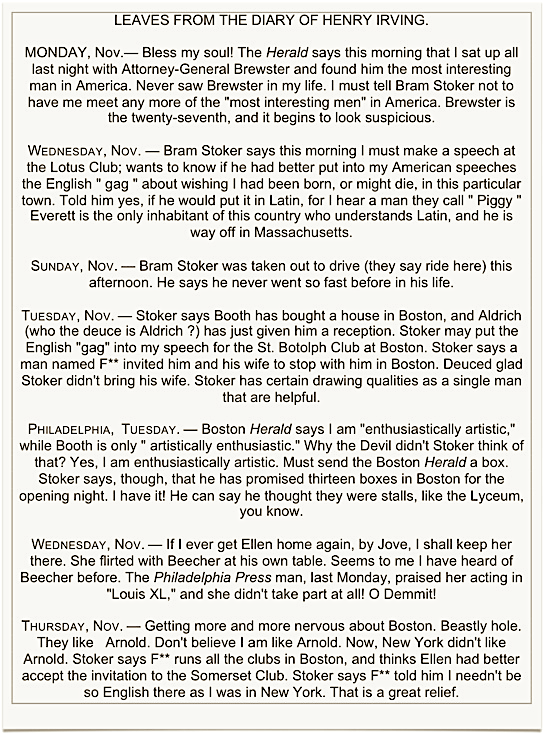
James Whitcomb Riley, popular poet, suggests his friend meet Bram and his brother, Dr. George Stoker. “Then they can professionally put their heads together – ‘talk shop’ and think it science – ignore us entirely, or hypnotize and cut us up all unbeknownst.”
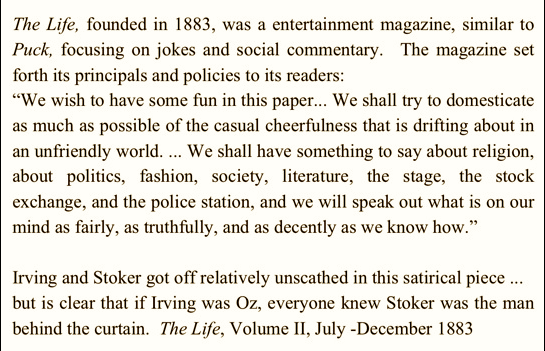
Letter to Bram Stoker from Mark Twain
“My Dear Stoker,
I am dating this because it is not to be mailed at present.
When it reaches you it will mean that there is a hitch in my machine-enterprise – a hitch so serious as to make it take to itself the aspect of a dissolved dream. This letter, then, will contain [the] cheque for the $100 which you have paid. And will you tell Irving for me – I can’t get up courage enough to talk about this misfortune, myself, except to you, whom by good luck I haven’t damaged yet – that when the wreckage presently floats ashore he will get a good deal of his $500 back; & a dab at a time I will make up to him the rest.
I’m not feeling as fine as I was when I saw you there in your home. Please remember me kindly to Mrs. Stoker. I gave up that London lecture project entirely. Had to – there’s never been a chance since to find the time.
Sincerely yours,
S.L. Clemens
I am taking it for granted you still abide at 17 St. Leonard’s Terrace Chelsea”
From Wallace’s American Trotting Register, 1895
Bram Stoker ’81, bay horse foaled 1881 by Col. Bullock 8M7, dam Western Belle by Robert McGregor 617 etc.
(See Western Belle Vol. V1IL)
Bred by William J. Davis, Crown Point, Ind.
BSE note: William J Davis was a Chicago theater manager, who bred trotting horses, fox-terriers and collies on his 1100 acre farm in Indiana.
Indianapolis, Ind., U.S.A., Aug. 19
– 1891 –
Bram Stoker, Esq., Lyceum Theatre –
London.
Dear Mr. Stoker,
Dr. Franklin Hayes, through life My loyal friend and chum, is just starting Your way, and promptly upon his arrival In London I want you two to meet, as
I feel assured that such an acquaintance
can but add to your mutual great store
of happiness.
Also I much desire, for like reasons, that he meet your brother, the doctor, at your hands. Then they can professionally put their heads together – “talk shop” and
think it science – ignore us entirely, or
hypnotize us and cut us up all unbe-knownst.
As ever faithfully yours,
James Whitcomb Riley
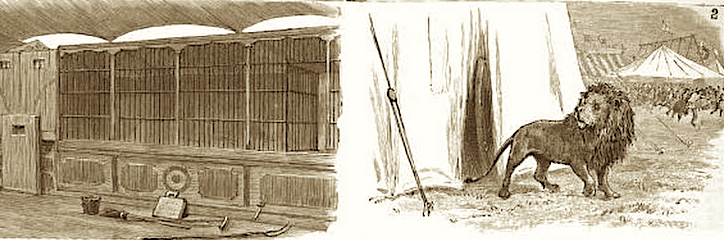
The Escape of Lions From the Menagerie at Birmingham
5 October 1889
“The Graphic”
From Studio to Stage: Reminiscences of Weedon Grossman Weedon Grossman (1912)
While touring with Irving I met George Alexander and Bram Stoker in New Street, Birmingham, one day, outside a small hall where a showman was announcing at the top of his voice that they were u just about to commence.” A magnificent African lion was pictured waltzing with the lion tamer. Alexander decided to see the performance, went in, and was charged sixpence. I followed, paying the same amount, but Bram Stoker was only asked fourpence – why I have never known. Bram Stoker was always well dressed, and looked worth the sixpence, but perhaps the showman thought he was poor as he was dressed in black. We all stood round the lion’s cage in a back-yard, where a tent had been erected, and the trainer, dressed in pink fleshings and a spangled belt, informed us briefly that” the lion was the largest and the fiercest it had ever been his good fortune to master.” A little boy said, ” ‘As he ever ate anyone?” The lion tamer, though a little annoyed at being interrupted, condescended to inform the lad that the noble beast had been responsible for the deaths of several human beings, both black and white, and many were injured during his capture. He then drew the curtains aside, and we were all bound to admit that the lion was a magnificent creature. He seemed in a very bad temper, perhaps it was the look of the house, the audience consisting of only nine persons, all told.
The noble beast was snarling and giving us a good view of his great teeth, and when he pressed against the bars of the cage they seemed to give with his weight. In fact, it all looked very dangerous, and I was turning over in my mind whether I wouldn’t have a cigarette outside, when the lion tamer seized a strong whip, opened the cage door, and leapt in. He struck the usual professional attitude, and then slashed the whip several times at the lion’s legs, who in response sprang at him, throwing him to the ground. For a moment we thought it was part of the business, but only for a moment; in another second, with extraordinary acrobatic skill, the tamer had twisted from under the lion and was out of the cage, but unfortunately he omitted to close the door after him. I have often seen a crowd leave a theatre hurriedly after a bad performance. I have seen guests at a party rushing for the door to get to the supper rooms when a gentleman has announced that he will recite “The Pit’s Mouth ” or “The Pride of Battery B.” But never have I seen a place emptied with such rapidity as that tent was. I did not wait to ask for my money back – there being no performance – nor did anyone else, I fancy. In three seconds I was in New Street, where I saw George Alexander and Bram Stoker jumping on to a passing bus, Stoker shouting to the conductor, ” Don’t stop for us, please, we can jump on.” I went into the nearest shop, it was an estate agent’s, and I closed the door after me because of the draught – for no other reason.
George Alexander – now Sir George – and a member of the County Council, may deny the veracity of this story, but it is absolutely true. Ask Lady Alexander, I am sure she will stand by me.
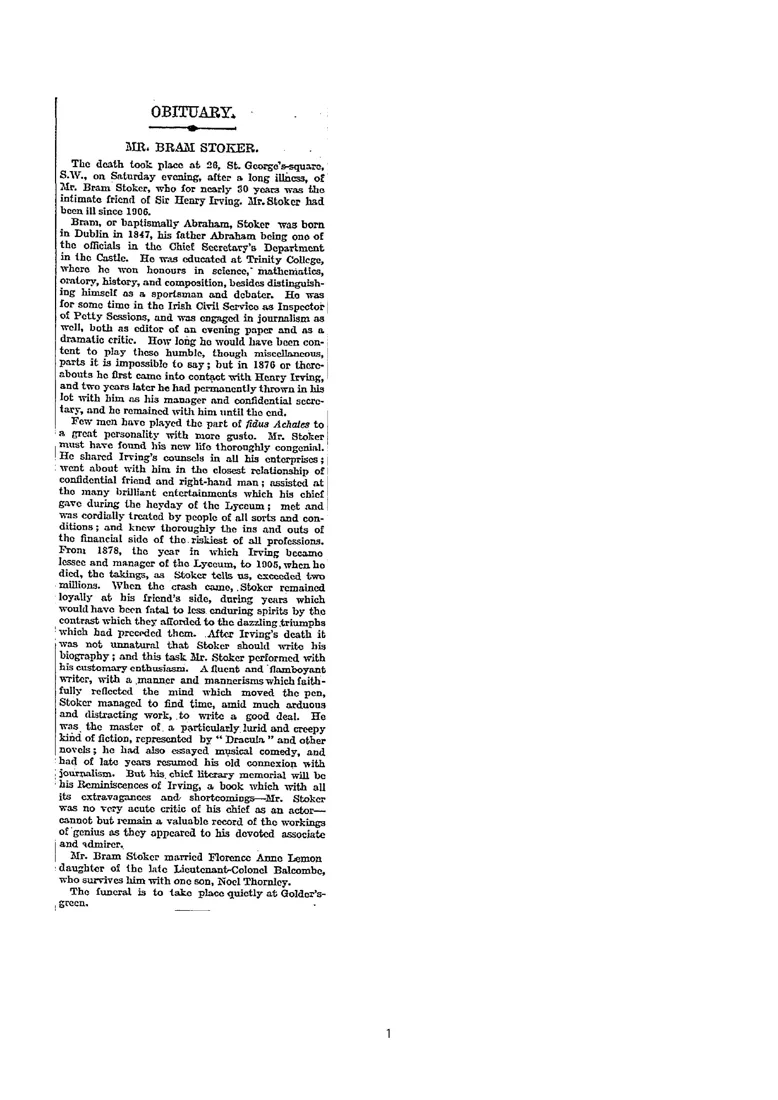
Excerpt from A Long Retrospect by Thomas Anstey Guthrie, aka F. Anstey (1854 - 1934), novelist, journalist, and friend of Bram Stoker
Ch. VII Friends and Acquaintances
Tall and burly, with blunt features, rather small but honest and kindly eyes, and a reddish pointed beard, Bram Stoker would probably not have impressed a first acquaintance as possessing any marked degree of diplomacy. And yet he had more than the average amount or he could not have acted as Henry Irving’s business manager for many years with unvarying skill and success. Nor did his genial rather boyish face suggest the slightest taste for the macabre, but he was the author of Dracula, perhaps the most blood-curdling story in the English language.
I’ve no doubt he thoroughly enjoyed writing it, for he had a pretty taste in vampires. Once when we were walking home from a party together late at night, he said, in the soft Irish accent I cannot attempt to suggest: ‘I’ve an idea for another story. It would open like this: A celebrated Harley Street doctor in his consulting-room, a patient shown in. The patient is a cadaverous-looking man, and evidently is very anxious about his health. For some time he cannot bring himself to speak out, but at last he tells the doctor, who of course is bound by his profession to secrecy, what is troubling him.
‘He is a vampire, and has just discovered that his latest victim is in a galloping consumption. So naturally he ’s in terror lest his own health may be affected. Now don’t you think that’s a strong situation, eh?’
It was such a strong situation that I laughed long and loud, until he joined in, and between us I’m afraid we must have awakened many a sleeper in that quiet Chelsea street.
I remember two of Bram’s stories of his Irish experiences which he told inimitably. One was of how, when he had undertaken to carve at supper during a dance, one of the maids came up and said, ‘If ye plase, Sorr, will ye cot me a slice of beef for the pianner.’
The other was of a visit to a country-house where the large staff of servants begged unblushingly for tips at parting, from the butler down to the page, who said pathetically, ‘Ah, spare a copper or two for the pore bottons!’