
resources
How Dracula came to be studied
The novel’s popularity and its academic reputation developed at different speeds. This feature traces that history using the Bram Stoker Estate records.
Historical material from the Bram Stoker Estate records. Original wording is retained in quoted sources.
Reputation and scholarship
Dracula
Since it was published in 1897, Bram Stoker’s Dracula has never gone out of print. That doesn’t just mean it is a popular book; it means that booksellers have literally never stopped requesting new print runs of Dracula , because they keep selling out their stock. For over 120 years straight. That’s a level of demand on par with the Bible, ironically enough.
Given Dracula ‘s popularity, it may come as a surprise that for almost seventy-five years after the novel’s publication, only two scholarly essays and one book centering on Dracula were written: Bacil Kirtley’s “Dracula, the Monastic Chronicles and Slavic Folk-Lore” (1956), Richard Wasson’s “The Politics of Dracula ” (1966), and Harry Ludlam’s biography, A Biography of Dracula: The Life Story of Bram Stoker (1962).
Here, oddly enough, the same reasons for Dracula ‘s popularity may have worked against its reputation among scholars. Bram’s story was received as a fantasy-thriller, not a work of serious literature or belles-lettres . Compare it to the mid-twentieth century reception of J.R.R. Tolkien’s Lord of the Rings books. Today Tolkien’s works are universally considered classics, but no English departments began to study them seriously until a sufficient groundswell of popularity encouraged it, and still some academics look down their noses at the idea of studying Tolkien’s “fantasy” as literature, even though he was an Oxford graduate, fellow, and professor of Anglo-Saxon and English language and literature
1972 was a watershed year for Dracula studies. You might say it was when Count Dracula received his invitation into the academy. In that year alone, more than half a dozen influential books and essays on Dracula were published. Several of these works foreshadow the heavily theoretical direction that academic studies of Dracula would take; Joseph Bierman’s “Dracula: Prolonged Childhood Illness and the Oral Triad” is an illustrative example. Bierman’s essay, which credulously takes Bram’s wisecrack about dreaming up Dracula after “eating too much dressed crab at supper one night” as its point of departure, exemplifies biographer Paul Murray’s observation that “Stoker was rediscovered primarily on the campuses of America by academics who found in his writings a cornucopia for interpretations driven by Freudianism, Marxism, and feminism. While great credit is due to those who first insisted that there was more than mere sensationalism in his writings, some of their conclusions, at least, were based on insufficient biographical research” ( From the Shadow of Dracula , 1).
While the Bram Stoker Estate has no ideological agenda, our mission of ensuring the availability of historically accurate information about Bram Stoker and his life necessarily informs our historically-inclined approach to the study of Bram and his writings.
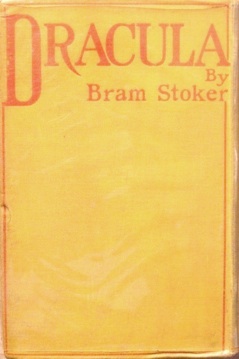
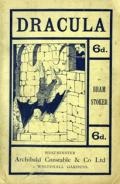
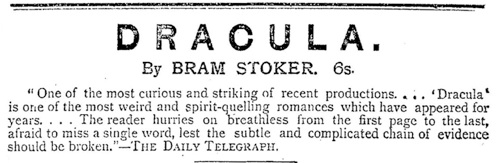
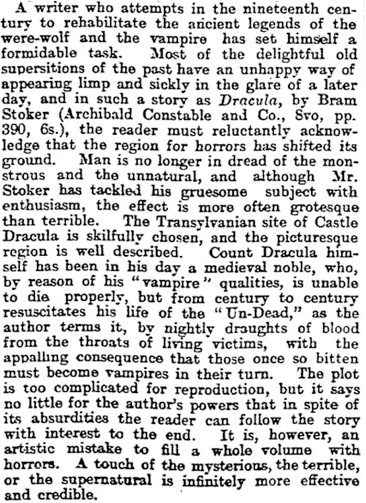
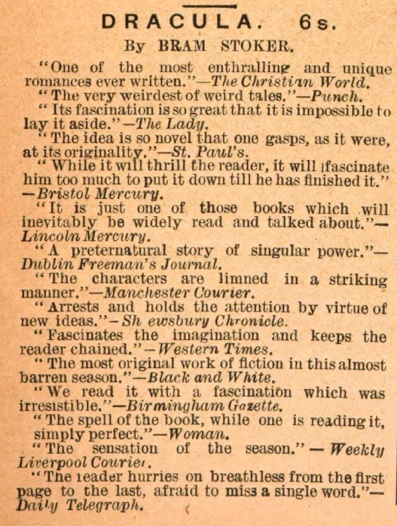
This advertisement for Dracula appeared in
The New Book List, General Theological Seminary, New York (1897) as part of a full-page colored inset of books offered by
Archibald Constable and Co.
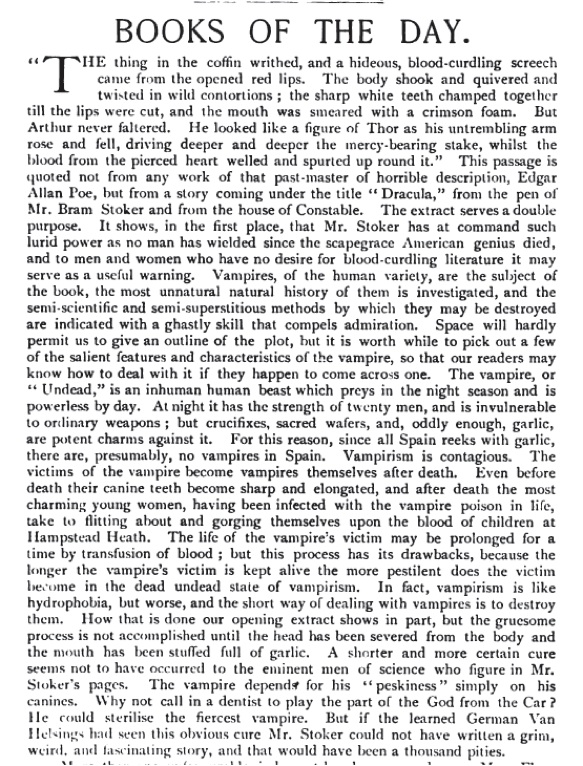
Originally published in the
Manchester Guardian on 15 June 1897
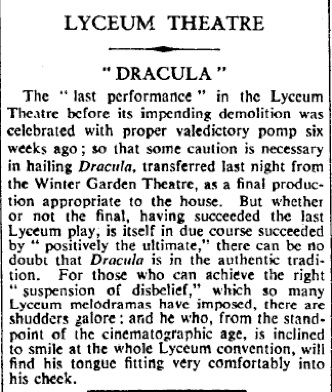
The Times, London
Wednesday, 26 April 1939
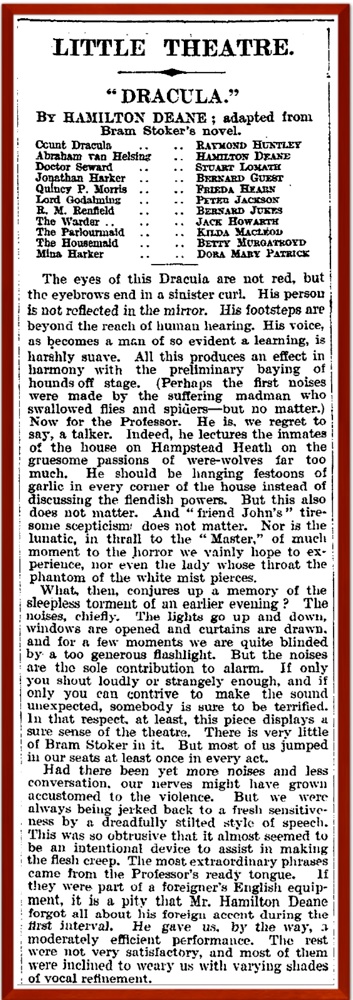
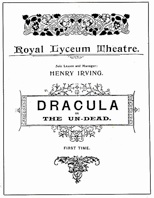
The Times, London
Tuesday, 15 February 1927
The man behind the book
Bram Stoker’s Dracula and Popular Culture
The Man Behind the Book
For an author of a world-famous book who has been dead for over a century, Bram Stoker represents a strange instance in which the efforts of literary historians have been outpaced by those of literary theorists. A number of factors aligned for this to happen. For one, the Stoker family did not become especially active in stewarding Bram’s legacy until Noel Thornley Stoker, Bram’s only son, assisted Harry Ludlam’s 1962 Biography of Dracula, which was something of a watershed in the telling of Bram’s life story. Bram himself was not exactly an active participant in his own time either; the closest he came to autobiography was his Personal Reminiscences of Henry Irving. Though Dracula was better received in its own time than is commonly realized, it would not be a stretch to say that Bram Stoker was better known for his managing role in London’s Lyceum Theatre – at the time, the leading theatre of the world’s leading city – than his work as an author.
Further reading
Read about Dracula, find editions and scholarship in the Bibliography, and explore the archives behind the research.