
US high-school study
Practising and revising
Build flexible knowledge through precise evidence, changing interpretations and practice questions. Use the seven-stage essay approach for researched preparation. Chapter C explains AP scoring; your teacher will guide examination technique.
Quotations and evidence
Open the quotation bank, key terms and critical readings. The quotations are grouped by subject and cited by chapter. Read the surrounding passage before selecting a quotation for your argument.
For each quotation, record its speaker, document and place in the plot; explain one detail of its language; then find another passage that complicates your reading. At step 5 of the essay guide, choose the key quotations and place them against the claims in your plan.
Build an evidence notebook you can adapt
- Keep the passage, not only the phrase. Record a quotation accurately, with speaker, document and chapter. Add what happens immediately before and after it; this helps prevent an attractive phrase from acquiring a meaning the scene cannot support.
- Give evidence more than one use. Mina’s compilation can support arguments about technology, cooperation, gender and proof. Write a different explanation for each use. The words remain the same; their contribution to an answer changes.
- Include a challenge. Pair a passage that supports your claim with one that limits it. Do not call Mina wholly excluded without recognising the work she continues to perform; do not call the ending wholly secure without reading the final note.
- Keep comparison paired. For a comparative course, place the two passages on the same page of your notebook. Record a similarity, a significant difference in method and a relevant difference in context. Use the pairing guides to begin, then select your own evidence.
Practice questions and passage analysis
Use the 60 Estate practice questions for classroom preparation. They include single-text and comparative tasks and are not official AP questions. For actual released AP prompts and fit checks, use Chapter C.
Choose a task and define it, lay out precise evidence, test relevant interpretations, form a provisional conclusion and select a structure. The comparative questions are for assignments that ask for comparison; do not turn AP Question 3 into a two-book response.
Unseen Gothic passages
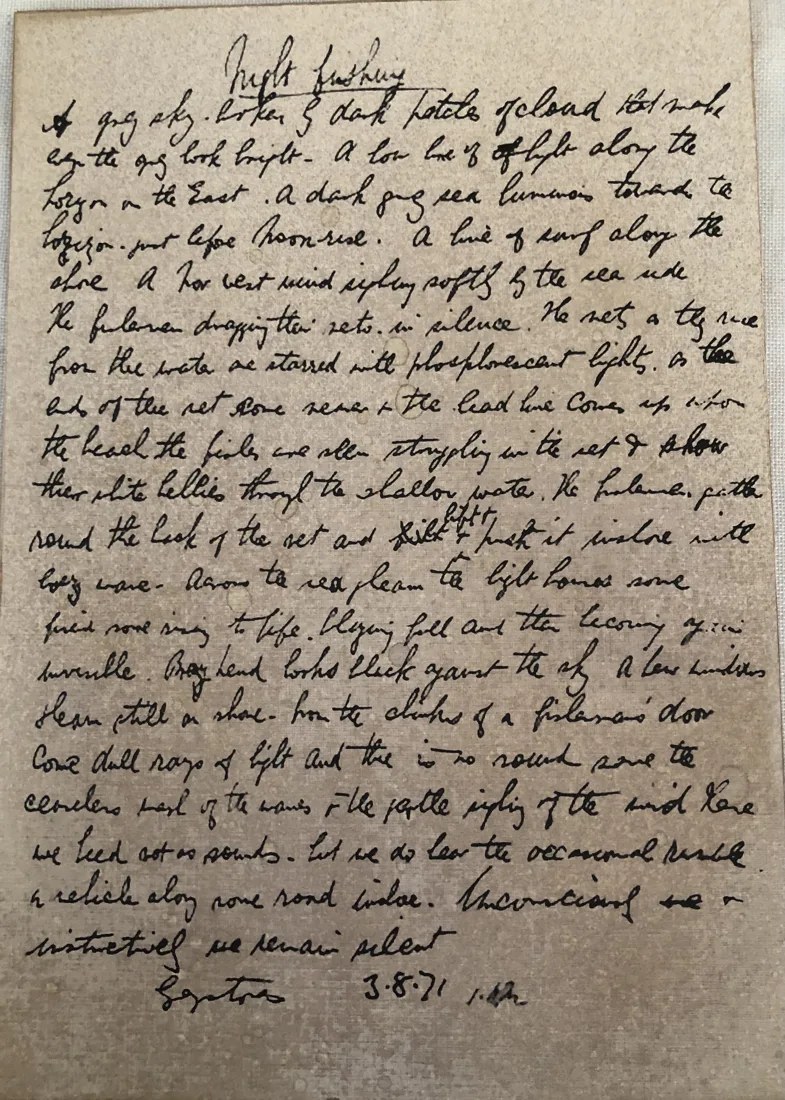
Several courses include an unseen Gothic passage. Practising on Stoker’s own shorter fiction lets students meet his habits of narration in a new setting.
- “The Judge’s House” (1891). A student seeks quiet lodgings in a house with a reputation. About 7,700 words; in Dracula’s Guest and Other Weird Stories (1914) and free at Project Gutenberg (ebook 10150). The opening 1,000 words make a complete unseen exercise on setting, rational narrator and rising dread.
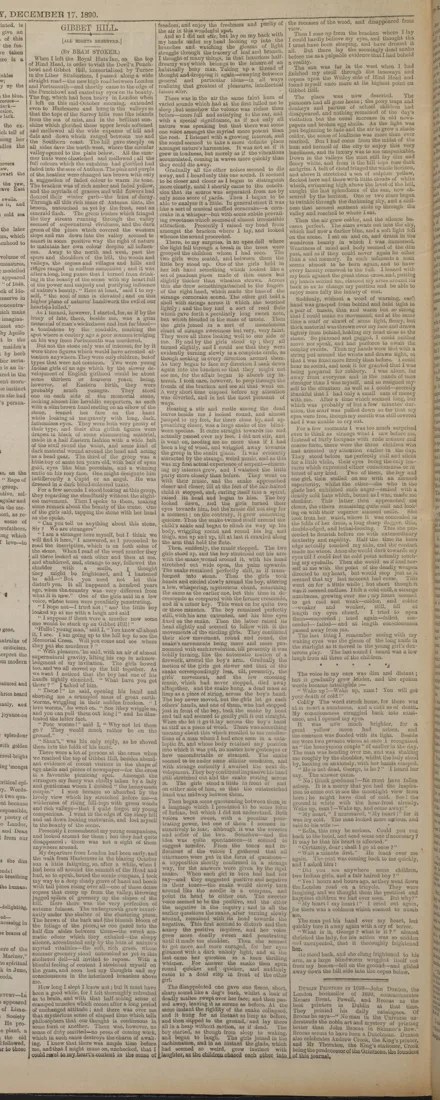
- Gibbet Hill (1890). A story rediscovered in the National Library of Ireland and announced in October 2024, first published in the Daily Express (Dublin) Christmas supplement of 17 December 1890. A walker on a Surrey hilltop, the memorial to a murdered sailor, three strange children and a blindworm: short enough to read in one lesson and potentially unfamiliar to students following its recent rediscovery. The original newspaper pages are linked from Gibbet Hill; a book edition with a foreword by Roddy Doyle followed in 2024.
- “Dracula’s Guest” (1914). Published after Bram’s death; about 4,900 words; an Englishman caught in a snowstorm near Munich on Walpurgis Night. Discuss its relation to the novel with care. Florence Stoker’s 1914 preface calls it an episode “originally excised owing to the length of the book”; the familiar claim that it was the novel’s deleted first chapter goes further than that evidence.
- The Demeter log (Chapter 7). Within the novel, the log reads as a free-standing found document and makes an unseen-style exercise for students who have not yet read the whole book.
Use these passages for preparation: read the headnote, identify the narrator, trace the sequence, then analyse three or four details of language and their relation to Gothic conventions. Do not assume that a set-text explanation applies. See Extract practice. These are Estate-written practice tasks, not official examination questions.
Horace Walpole, The Castle of Otranto (1764)
The Castle of Otranto (1764) by Horace Walpole. In this extract, Isabella, escaping at night from Manfred, the prince who means to marry her by force, looks for the secret passage beneath his castle.
Read the passage (392 words)
As these thoughts passed rapidly through her mind, she recollected a subterraneous passage which led from the vaults of the castle to the church of St. Nicholas. Could she reach the altar before she was overtaken, she knew even Manfred’s violence would not dare to profane the sacredness of the place; and she determined, if no other means of deliverance offered, to shut herself up for ever among the holy virgins whose convent was contiguous to the cathedral. In this resolution, she seized a lamp that burned at the foot of the staircase, and hurried towards the secret passage.
The lower part of the castle was hollowed into several intricate cloisters; and it was not easy for one under so much anxiety to find the door that opened into the cavern. An awful silence reigned throughout those subterraneous regions, except now and then some blasts of wind that shook the doors she had passed, and which, grating on the rusty hinges, were re-echoed through that long labyrinth of darkness. Every murmur struck her with new terror; yet more she dreaded to hear the wrathful voice of Manfred urging his domestics to pursue her.
She trod as softly as impatience would give her leave, yet frequently stopped and listened to hear if she was followed. In one of those moments she thought she heard a sigh. She shuddered, and recoiled a few paces. In a moment she thought she heard the step of some person. Her blood curdled; she concluded it was Manfred. Every suggestion that horror could inspire rushed into her mind. She condemned her rash flight, which had thus exposed her to his rage in a place where her cries were not likely to draw anybody to her assistance. Yet the sound seemed not to come from behind. If Manfred knew where she was, he must have followed her. She was still in one of the cloisters, and the steps she had heard were too distinct to proceed from the way she had come. Cheered with this reflection, and hoping to find a friend in whoever was not the Prince, she was going to advance, when a door that stood ajar, at some distance to the left, was opened gently: but ere her lamp, which she held up, could discover who opened it, the person retreated precipitately on seeing the light.
Practice task: Explore how the writer creates a sense of threat in this passage. Base your reading on its language, form and structure, drawing on Gothic conventions where they help.
Text and edition source · Read the complete work.
Ann Radcliffe, The Mysteries of Udolpho (1794)
The Mysteries of Udolpho (1794) by Ann Radcliffe. In this extract, Emily St Aubert, held at the remote castle of Udolpho by her aunt’s husband, Montoni, decides to look at a veiled picture she has heard rumours about.
Read the passage (291 words)
To withdraw her thoughts, however, from the subject of her misfortunes, she attempted to read, but her attention wandered from the page, and, at length, she threw aside the book, and determined to explore the adjoining chambers of the castle. Her imagination was pleased with the view of ancient grandeur, and an emotion of melancholy awe awakened all its powers, as she walked through rooms, obscure and desolate, where no footsteps had passed probably for many years, and remembered the strange history of the former possessor of the edifice. This brought to her recollection the veiled picture, which had attracted her curiosity, on the preceding night, and she resolved to examine it. As she passed through the chambers, that led to this, she found herself somewhat agitated; its connection with the late lady of the castle, and the conversation of Annette, together with the circumstance of the veil, throwing a mystery over the subject, that excited a faint degree of terror. But a terror of this nature, as it occupies and expands the mind, and elevates it to high expectation, is purely sublime, and leads us, by a kind of fascination, to seek even the object, from which we appear to shrink.
Emily passed on with faltering steps, and having paused a moment at the door, before she attempted to open it, she then hastily entered the chamber, and went towards the picture, which appeared to be enclosed in a frame of uncommon size, that hung in a dark part of the room. She paused again, and then, with a timid hand, lifted the veil; but instantly let it fall — perceiving that what it had concealed was no picture, and, before she could leave the chamber, she dropped senseless on the floor.
Practice task: Explore how the writer creates a sense of threat in this passage. Base your reading on its language, form and structure, drawing on Gothic conventions where they help.
Text and edition source · Read the complete work.
Mary Shelley, Frankenstein (1818)
Frankenstein; or, The Modern Prometheus (1818) by Mary Shelley. In this extract, Victor Frankenstein, a student at Ingolstadt, describes the night when the being he has made comes to life. The passage follows the 1818 text (Volume I, Chapter IV), not the revised 1831 edition.
Read the passage (432 words)
It was on a dreary night of November, that I beheld the accomplishment of my toils. With an anxiety that almost amounted to agony, I collected the instruments of life around me, that I might infuse a spark of being into the lifeless thing that lay at my feet. It was already one in the morning; the rain pattered dismally against the panes, and my candle was nearly burnt out, when, by the glimmer of the half-extinguished light, I saw the dull yellow eye of the creature open; it breathed hard, and a convulsive motion agitated its limbs.
How can I describe my emotions at this catastrophe, or how delineate the wretch whom with such infinite pains and care I had endeavoured to form? His limbs were in proportion, and I had selected his features as beautiful. Beautiful! — Great God! His yellow skin scarcely covered the work of muscles and arteries beneath; his hair was of a lustrous black, and flowing; his teeth of a pearly whiteness; but these luxuriances only formed a more horrid contrast with his watery eyes, that seemed almost of the same colour as the dun white sockets in which they were set, his shrivelled complexion, and straight black lips.
The different accidents of life are not so changeable as the feelings of human nature. I had worked hard for nearly two years, for the sole purpose of infusing life into an inanimate body. For this I had deprived myself of rest and health. I had desired it with an ardour that far exceeded moderation; but now that I had finished, the beauty of the dream vanished, and breathless horror and disgust filled my heart. Unable to endure the aspect of the being I had created, I rushed out of the room, and continued a long time traversing my bed-chamber, unable to compose my mind to sleep. At length lassitude succeeded to the tumult I had before endured; and I threw myself on the bed in my clothes, endeavouring to seek a few moments of forgetfulness. But it was in vain: I slept indeed, but I was disturbed by the wildest dreams. I thought I saw Elizabeth, in the bloom of health, walking in the streets of Ingolstadt. Delighted and surprised, I embraced her; but as I imprinted the first kiss on her lips, they became livid with the hue of death; her features appeared to change, and I thought that I held the corpse of my dead mother in my arms; a shroud enveloped her form, and I saw the grave-worms crawling in the folds of the flannel.
Practice task: Explore how the writer creates a sense of threat in this passage. Base your reading on its language, form and structure, drawing on Gothic conventions where they help.
Text and edition source · Read the complete work.
Sheridan Le Fanu, “Carmilla” (1872)
“Carmilla” (1872) by Sheridan Le Fanu. In this extract, Laura, who lives with her father in a remote castle in Styria, visits a young woman left in their care after a carriage accident.
Read the passage (315 words)
Our visitor lay in one of the handsomest rooms in the schloss. It was, perhaps, a little stately. There was a somber piece of tapestry opposite the foot of the bed, representing Cleopatra with the asps to her bosom; and other solemn classic scenes were displayed, a little faded, upon the other walls. But there was gold carving, and rich and varied color enough in the other decorations of the room, to more than redeem the gloom of the old tapestry.
There were candles at the bedside. She was sitting up; her slender pretty figure enveloped in the soft silk dressing gown, embroidered with flowers, and lined with thick quilted silk, which her mother had thrown over her feet as she lay upon the ground.
What was it that, as I reached the bedside and had just begun my little greeting, struck me dumb in a moment, and made me recoil a step or two from before her? I will tell you.
I saw the very face which had visited me in my childhood at night, which remained so fixed in my memory, and on which I had for so many years so often ruminated with horror, when no one suspected of what I was thinking.
It was pretty, even beautiful; and when I first beheld it, wore the same melancholy expression.
But this almost instantly lighted into a strange fixed smile of recognition.
There was a silence of fully a minute, and then at length she spoke; I could not.
“How wonderful!” she exclaimed. “Twelve years ago, I saw your face in a dream, and it has haunted me ever since.”
“Wonderful indeed!” I repeated, overcoming with an effort the horror that had for a time suspended my utterances. “Twelve years ago, in vision or reality, I certainly saw you. I could not forget your face. It has remained before my eyes ever since.”
Practice task: Explore how the writer creates a sense of threat in this passage. Base your reading on its language, form and structure, drawing on Gothic conventions where they help.
Text and edition source · Read the complete work.
Robert Louis Stevenson, Strange Case of Dr Jekyll and Mr Hyde (1886)
Strange Case of Dr Jekyll and Mr Hyde (1886) by Robert Louis Stevenson. In this extract, from the chapter “Story of the Door”, Mr Enfield tells his kinsman Mr Utterson, a lawyer, about something he saw in a London street in the early hours of a winter morning.
Read the passage (396 words)
“Well, it was this way,” returned Mr. Enfield: “I was coming home from some place at the end of the world, about three o’clock of a black winter morning, and my way lay through a part of town where there was literally nothing to be seen but lamps. Street after street and all the folks asleep — street after street, all lighted up as if for a procession and all as empty as a church — till at last I got into that state of mind when a man listens and listens and begins to long for the sight of a policeman. All at once, I saw two figures: one a little man who was stumping along eastward at a good walk, and the other a girl of maybe eight or ten who was running as hard as she was able down a cross street. Well, sir, the two ran into one another naturally enough at the corner; and then came the horrible part of the thing; for the man trampled calmly over the child’s body and left her screaming on the ground. It sounds nothing to hear, but it was hellish to see. It wasn’t like a man; it was like some damned Juggernaut. I gave a few halloa, took to my heels, collared my gentleman, and brought him back to where there was already quite a group about the screaming child. He was perfectly cool and made no resistance, but gave me one look, so ugly that it brought out the sweat on me like running. The people who had turned out were the girl’s own family; and pretty soon, the doctor, for whom she had been sent, put in his appearance. Well, the child was not much the worse, more frightened, according to the Sawbones; and there you might have supposed would be an end to it. But there was one curious circumstance. I had taken a loathing to my gentleman at first sight. So had the child’s family, which was only natural. But the doctor’s case was what struck me. He was the usual cut and dry apothecary, of no particular age and colour, with a strong Edinburgh accent and about as emotional as a bagpipe. Well, sir, he was like the rest of us; every time he looked at my prisoner, I saw that Sawbones turn sick and white with the desire to kill him.
Practice task: Explore how the writer creates a sense of threat in this passage. Base your reading on its language, form and structure, drawing on Gothic conventions where they help.
Text and edition source · Read the complete work.
Richard Marsh, The Beetle (1897)
The Beetle (1897) by Richard Marsh. In this extract, the narrator, a clerk out of work who has been turned away from the workhouse, finds an empty-looking house on a wet night in the London suburbs.
Read the passage (424 words)
Above all, I saw the open window. I stared at it, conscious, as I did so, of a curious catching of the breath. It was so near to me; so very near. I had but to stretch out my hand to thrust it through the aperture. Once inside, my hand would at least be dry. How it rained out there! My scanty clothing was soaked; I was wet to the skin! I was shivering. And, each second, it seemed to rain still faster. My teeth were chattering. The damp was liquefying the very marrow in my bones.
And, inside that open window, it was, it must be, so warm, so dry!
There was not a soul in sight. Not a human being anywhere near. I listened; there was not a sound. I alone was at the mercy of the sodden night. Of all God’s creatures the only one unsheltered from the fountains of Heaven which He had opened. There was not one to see what I might do; not one to care. I need fear no spy.
Perhaps the house was empty; nay, probably. It was my plain duty to knock at the door, rouse the inmates, and call attention to their oversight, — the open window. The least they could do would be to reward me for my pains. But, suppose the place was empty, what would be the use of knocking? It would be to make a useless clatter. Possibly to disturb the neighbourhood, for nothing. And, even if the people were at home, I might go unrewarded. I had learned, in a hard school, the world’s ingratitude. To have caused the window to be closed — the inviting window, the tempting window, the convenient window! — and then to be no better for it after all, but still to be penniless, hopeless, hungry, out in the cold and the rain — better anything than that. In such a situation, too late, I should say to myself that mine had been the conduct of a fool. And I should say it justly too. To be sure.
Leaning over the low wall I found that I could very easily put my hand inside the room. How warm it was in there! I could feel the difference of temperature in my fingertips. Very quietly I stepped right over the wall. There was just room to stand in comfort between the window and the wall. The ground felt to the foot as if it were cemented. Stooping down, I peered through the opening. I could see nothing. It was black as pitch inside.
Practice task: Explore how the writer creates a sense of threat in this passage. Base your reading on its language, form and structure, drawing on Gothic conventions where they help.
Revision planning and avoiding common mistakes
Avoiding common mistakes
Avoid plot summary, vague evidence, feature spotting and an answer that misses the prompt. Separate these Estate writing checks from specific published reader findings: Avoiding common mistakes and AP reader feedback.
A six-week revision plan
A six-week preparation plan, to adapt with your teacher: 1. Read and map the plot. 2. Track characters and gather precise passages. 3. Investigate narration and structure. 4. Test contexts and alternative readings where useful. 5. Plan responses to different prompts, rejecting poor fits. 6. Draft, discuss and revise the weakest part of an argument.
For AP Question 3, practise recalling specific events accurately as well as learning short quotations. Timed examination practice belongs with your teacher’s guidance.
Quiz: test your knowledge
Test your understanding of the novel and Bram’s world. Choose novel-only rounds and a difficulty level; after an incorrect answer, follow the link to the page that explains it.
Where next?
Previous: E – Writing your own essay · Back to US-system study
What would make your preparation easier? Suggest a question, exercise or explanation that would help you or future students.
Prepared by the Bram Stoker Estate. Page last updated 8 November 2026. Report a correction here.