
resources
Where is Castle Dracula?
Nobody knows exactly where Castle Dracula stands, because Bram Stoker never tells his readers. The castle itself is made up: no real building ever matched it. But Bram put it in a real landscape, in the mountains of Transylvania, which today is part of Romania. Nearly 130 years after the book came out, experts, readers and tourist attractions still place it in different locations. Some experts think Bram had one particular mountain in mind but hid it on purpose. Others think he never chose an exact spot. A third view is that Bram deliberately left the location ambiguous as part of the mystery: even after searching the British Museum for information about Transylvania, Harker cannot find a map or book showing the exact position of Castle Dracula. All sides have good arguments!
The terrain map below sets Harker’s northern journey beside Bran Castle, much further south. It shows the places discussed in the two main readings and helps explain why a famous tourist castle is not the same thing as the castle’s location in the novel.
Castle Dracula in the Romanian landscape
The map places Harker’s outward journey beside the final pursuit and other places discussed below. Every coloured dot has a label; the longer, thin arrows connect labels to their locations. Zoom in for hills, contour lines, roads and smaller settlements.
Map key
- Harker’s outward journey. Klausenburgh, Bistritz, Borgo Prund and the Borgo Pass. The pass also features in the final pursuit.
- The final journey towards the castle. Galatz, the Sereth and Bistritza rivers, and Veresti show places in the different branches of the pursuit. River dots identify the rivers, rather than exact stops.
- Places not explicitly mentioned in Dracula but with a potential link. Călimani Mountains, Dornișoara, Bran Castle, and Brașov are not named in the novel. Their links differ: a proposed castle location, a village in a possible route, modern Dracula tourism that might have been one of the inspirations of Dracula, and a nearby city – see below.
- A possible area for the fictional Castle Dracula. It covers the competing Borgo Pass and Călimani interpretations. It is a broad illustrative area, not a proven site or historical boundary.
No exact carriage route is asserted. The background map also labels modern towns and cities.
- Klausenburgh (Cluj-Napoca)
- Harker stays here on 2 May, recording the visit in his journal entry of 3 May, before travelling to Bistritz.
- Bistritz (Bistrița)
- Harker stays at the Golden Krone before taking the public coach into the mountains.
- Borgo Prund (Prundu Bârgăului)
- A village on Harker’s outward coach journey along the Bârgău valley towards the pass.
- Borgo Pass (Pasul Tihuța)
- Harker leaves the public coach here and meets the Count’s carriage. Mina and Van Helsing also approach the pass during the final pursuit, so this place belongs to both journeys.
- Galatz (Galați)
- The Count’s box arrives here by ship on his return from England. The pursuers discover that it has been sent upriver and divide to follow it.
- Sereth river (Siret)
- The Count’s return journey follows the Sereth towards the Bistritza. This dot identifies the real river for orientation; it does not mark a stop or an exact point in the fictional journey.
- Bistritza river (Bistrița)
- The Count’s box is carried upstream towards the mountains; Harker and Godalming pursue it by launch. This river is distinct from the town of Bistritz. The dot identifies the river, rather than a particular stop.
- Veresti (Verești)
- Mina and Van Helsing leave the train here and buy a carriage and horses for their journey towards the Borgo Pass. Their route is one branch of the final pursuit.
- Dornișoara
- A village on the route proposed by Hans Corneel de Roos towards the Călimani Mountains. It is not named in the novel.
- Călimani Mountains
- The volcanic mountain landscape containing de Roos’s proposed Mount Izvorul Călimanului site. Neither the mountains nor the summit is named in the novel; the proposed site is an interpretation.
- Bran Castle
- The real castle near Brașov marketed as “Dracula’s Castle”. It is not named in the novel and lies well south of Harker’s outward journey.
- Brașov
- A city near Bran Castle, shown for orientation. It is not a stopping place in the novel’s journeys.
Story references: Dracula, Chapters 1 and 26–27. Read the Borgo Pass interpretation · Read the Călimani interpretation · Explore the other places in Bram’s fiction →
A castle no map could show
Bram builds the mystery into the very first pages. The story is told through diaries and letters, and it opens with the diary of Jonathan Harker, a young English solicitor travelling to visit Count Dracula. Before leaving England, Harker searches the British Museum for information about Transylvania but cannot find a map or book giving the exact position of Castle Dracula. So the missing location is part of the story itself. It is not just an address that we can look up on a modern map.
Bram never visited Transylvania. He built his picture of it from travel books, history books, folk tales and maps. His early plans placed the story in Styria, a region of Austria, before he moved it further east. At Whitby, on the Yorkshire coast, in 1890 he came across the name Dracula in William Wilkinson’s book about Wallachia and Moldavia. Bram’s working notes still survive. They show the story changing over several years: some ideas were kept, some were changed and some were dropped.
Place names then and now
We use the place names as Bram wrote them in Dracula, followed by their modern or alternative names. In Bram’s time Transylvania belonged to the Kingdom of Hungary, part of the Austro-Hungarian Empire. Its Saxon history helps explain why German place names were widely used on nineteenth-century maps and in travel books. Bram used German forms such as Bistritz and Klausenburgh. After the First World War Transylvania became part of Romania; Romanian names are used on modern maps.
- Bistritz (known today in Romanian as Bistrița and in Hungarian as Beszterce) is a town in northern Romania. It is real, and it is in the book: Harker spends the night there at the Golden Krone Hotel before setting off for the castle.
- Borgo Pass (known today in Romanian as Pasul Tihuța). A pass is a road through a gap in the mountains. This one is real and lies north-east of Bistritz, in the Bârgău Mountains, which is where the name Borgo comes from. It is in the book: it is where Harker gets off the public coach and is collected by the Count’s carriage. The village at the top of the pass today is Piatra Fântânele.
- Bistritza (known today in Romanian as the Bistrița river). Be careful: this river is not the same place as the town of Bistritz, even though the names look almost the same. It flows through the old region of Moldavia and joins the Sereth river. Near the end of the book the Count’s box is carried up this river.
- Sereth (known today in Romanian as the Siret), a river that flows from Ukraine through eastern Romania to the Danube.
- Galatz (known today in Romanian as Galați), a port on the river Danube in eastern Romania. The Count’s box arrives here by ship from England.
- Klausenburgh (known today in Romanian as Cluj-Napoca, in Hungarian as Kolozsvár, and in German as Klausenburg) is a large city in Transylvania where Harker stops on his way to Bistritz. We retain Bram’s spelling, Klausenburgh.
- Buda-Pesth (known today as Budapest), the capital of Hungary.
- Transylvania, Moldavia and Bukovina are old regions. In the book, Harker is told that the Count’s district is on the borders of all three. Transylvania is now part of Romania. Moldavia is split between Romania and the separate country of Moldova. Bukovina is split between Romania and Ukraine.
- Wallachia is the region of southern Romania where the real Vlad III, known as Dracula, ruled in the 1400s.
- Not in the book: Mount Izvorul Călimanului, the Călimani Mountains, Dornișoara, Bran Castle and Poenari Castle are all real places, but none of them is named in Dracula. They are part of the story only because researchers or the tourist trade have linked them to it.
What the novel tells us
The novel offers several kinds of clue. Harker travels by public coach from Bistritz and leaves it at the Borgo Pass late at night. The Count’s calèche, a light horse-drawn carriage, then drives on for hours before reaching the castle. Harker suspects it sometimes goes round in circles over the same ground, so it is hard to work out how far it really travels. The castle stands on the edge of a huge cliff, above forests and deep valleys, in the district where Transylvania, Moldavia and Bukovina meet.
The Count’s journey home at the end of the book supplies a second set of clues. His box of earth is brought by ship to Galatz (today Galați), then carried by boat up the Sereth (today the Siret) and the Bistritza river (today the Bistrița), before continuing over land into the mountains. In his diary Harker guesses that the Count’s helpers will cross the country between the river and the Carpathian mountains ‘somewhere about the 47th degree, north latitude’. A line of latitude is an imaginary line around the Earth that shows how far north or south a place is, and the 47th runs across northern Romania. Harker is describing part of a route here, not the exact position of the castle.
The puzzle is that these clues do not fit together perfectly. How long does the calèche’s journey really take? How far does it go if it keeps doubling back? Should the cliff be matched to a real mountain at all? And should a novel’s journey times and rivers be expected to match real geography exactly?
Reading 1: no exact spot, near the Borgo Pass
Many editors of Dracula, including Leonard Wolf, Clive Leatherdale and Leslie Klinger, think Bram never chose an exact spot, and that the castle’s location is meant to stay vague. The scholar Elizabeth Miller has also doubted that the evidence points to one exact site. When these editors need to put the castle on a map, they place it in or close to the Borgo Pass itself (today Pasul Tihuța), because that is the real place named in the book where Harker meets the Count’s carriage. The Hotel Castel Dracula at Piatra Fântânele, at the top of the pass, has made this the best-known spot.
The strength of this reading is that it sticks closely to a place named in the novel. Its difficulty is the journey that follows: Harker does not step from the public coach straight into the castle, but still has a long drive ahead. Anyone who pins the castle to the pass itself has to explain that drive, as well as the Count’s route home up the Bistritza river.
Reading 2: Mount Izvorul Călimanului
The Dutch researcher Hans Corneel de Roos argues that Bram did choose a real spot: Mount Izvorul Călimanului, a peak 2,033 metres high in the Călimani Mountains, about 30 km (around 20 miles) south-east of the pass. The Călimani Mountains are the remains of an ancient volcano, and the peak sits on the rim of its huge crater, called a caldera. His reconstruction follows a route from the pass towards the village of Dornișoara and on to the mountain. None of these places is named in the novel.
De Roos combines clues from the novel with Bram’s working notes and maps from Bram’s time. The notes include a latitude and longitude for a border crossing near the Borgo Pass (de Roos believes Bram swapped the two numbers by mistake) and the word Izvorul, which de Roos links to the mountain. In his reading, Bram picked this exact spot and then hid it in the published story. De Roos is describing what Bram had in mind; he does not claim that a real Castle Dracula ever stood on the summit. A plaque has since been placed there to mark the link.
Why the argument continues
Paul Murray, who wrote a major biography of Bram, challenged de Roos’s conclusions in an article called ‘A Tour of Dracula’s Transylvania’ in 2023. Another researcher, Brian Coffey, also questioned them. De Roos published a detailed reply to both in 2025. Their disagreement is mostly about how Bram’s notes, the numbers in them and the finished novel should be read together.
Murray warns against treating the notes as a secret key to the finished novel: an idea Bram jotted down may not have survived into the final story. De Roos says the notes and the story, taken together, show a deliberate choice. They also disagree about what the numbers in the notes describe, and how closely the real landscape needs to match the journey in the book.
It helps to see that there are really three separate questions. First, where does the published novel let a reader place the castle? Second, did Bram privately choose one exact spot? Third, how closely should a made-up journey match real geography? A convincing answer to one does not automatically settle the others. And the fact that experts disagree does not prove either that Bram was careless or that he was hiding something on purpose.
The deleted volcanic ending
The published novel leaves Castle Dracula standing. An earlier version in Bram’s typescript would have destroyed it after the Count’s death. The deleted passage describes a “terrible convulsion of the earth”, with the castle and its hill thrown upwards before collapsing. It is evidence of an ending Bram considered and then abandoned.
The reason for the cut is uncertain. A possible sequel and a resemblance to the ending of Edgar Allan Poe’s “The Fall of the House of Usher” have been suggested, but neither explanation should be treated as established fact.
In “The Volcano and the Vampire” (2025), Laura Eastlake reads the passage alongside a wider Gothic tradition: Varney the Vampire ends at Vesuvius, and some early stage versions of Frankenstein use Mount Etna. She also discusses the 2019 plaque at Mount Izvorul Călimanului, which connects the volcanic landscape with the deleted ending.
That connection contributes to the debate about the Călimani Mountains, but it does not settle the castle’s precise position. A discarded supernatural climax cannot by itself identify a real summit, or show what Bram intended readers of the finished novel to imagine.
Where the castle’s look came from
Where the castle is and what it looks like are different questions. Bram could place the castle in the Carpathian mountains while borrowing details from real buildings, pictures and landscapes somewhere else.
Suggested visual sources include the castle at Vécs (today Brâncovenești, in Romania), described by Major E. C. Johnson in his 1885 travel book, and pictures in Transylvanian travel books such as Charles Boner’s Transylvania (1865), which may have shown Bram what Bran Castle looked like. These are possible influences, not proof that the castle was copied from one building.
Slains Castle near Cruden Bay, in Scotland, is a particularly interesting comparison. Bram knew the coast there well and wrote part of Dracula at Cruden Bay. Slains had an eight-sided (octagonal) hall, which has been compared with the small eight-sided room with no windows in Chapter 2 of Dracula. But, as the Cruden Bay walking guide points out, there is no written evidence that Bram ever went inside Slains. And even if it inspired a room, it would tell us nothing about where the fictional castle is.
Other castles linked with Dracula
Bran Castle (in German, Törzburg) near Brașov in central Romania is famous worldwide as ‘Dracula’s Castle’, but it never appears in the novel and lies about 200 km south of the Borgo Pass. Its fame comes from modern tourism, not from evidence about where Bram imagined the castle. And even if Bram saw a picture of Bran in a travel book, that would not mean he chose it as the castle’s location.
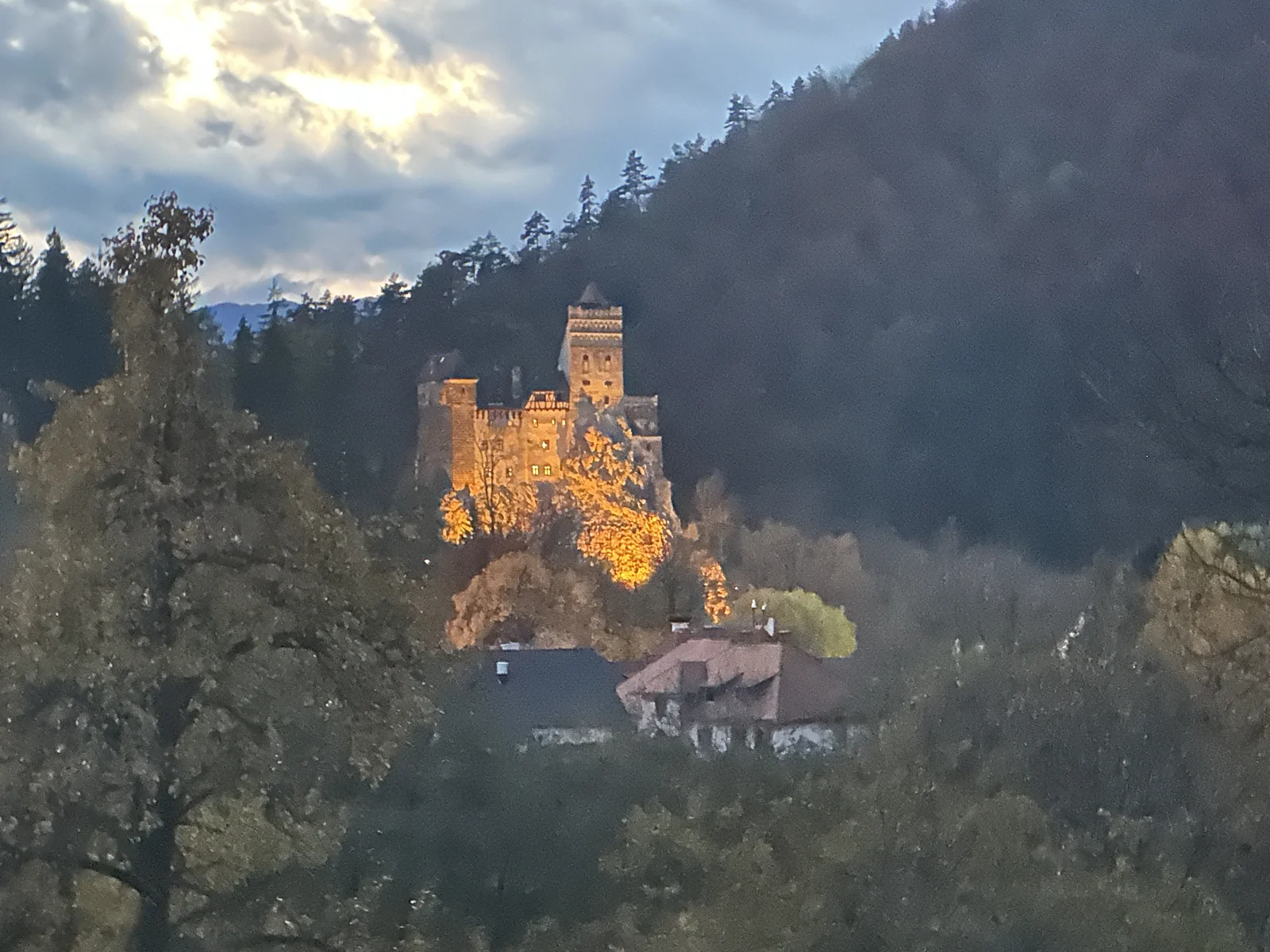
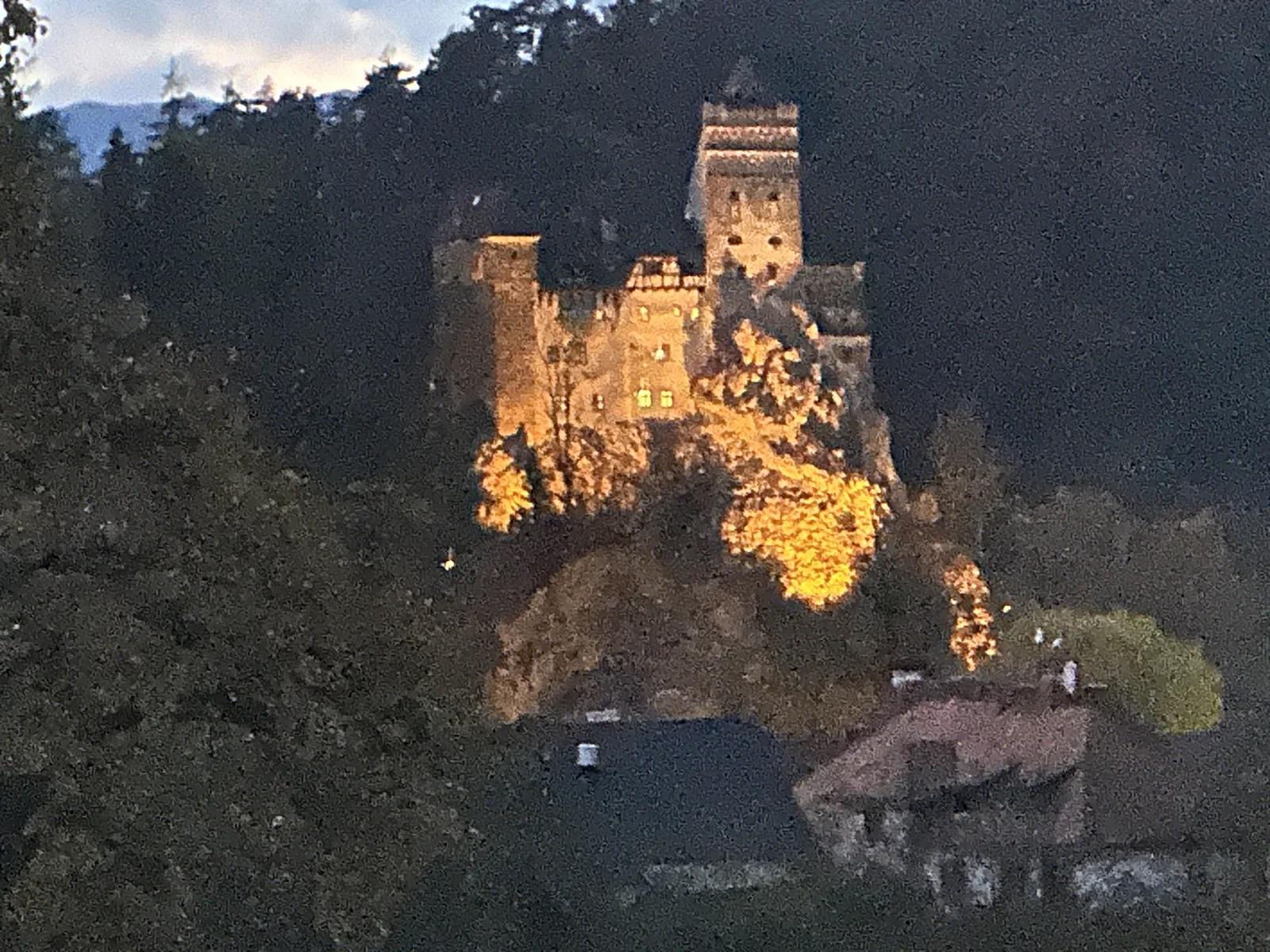
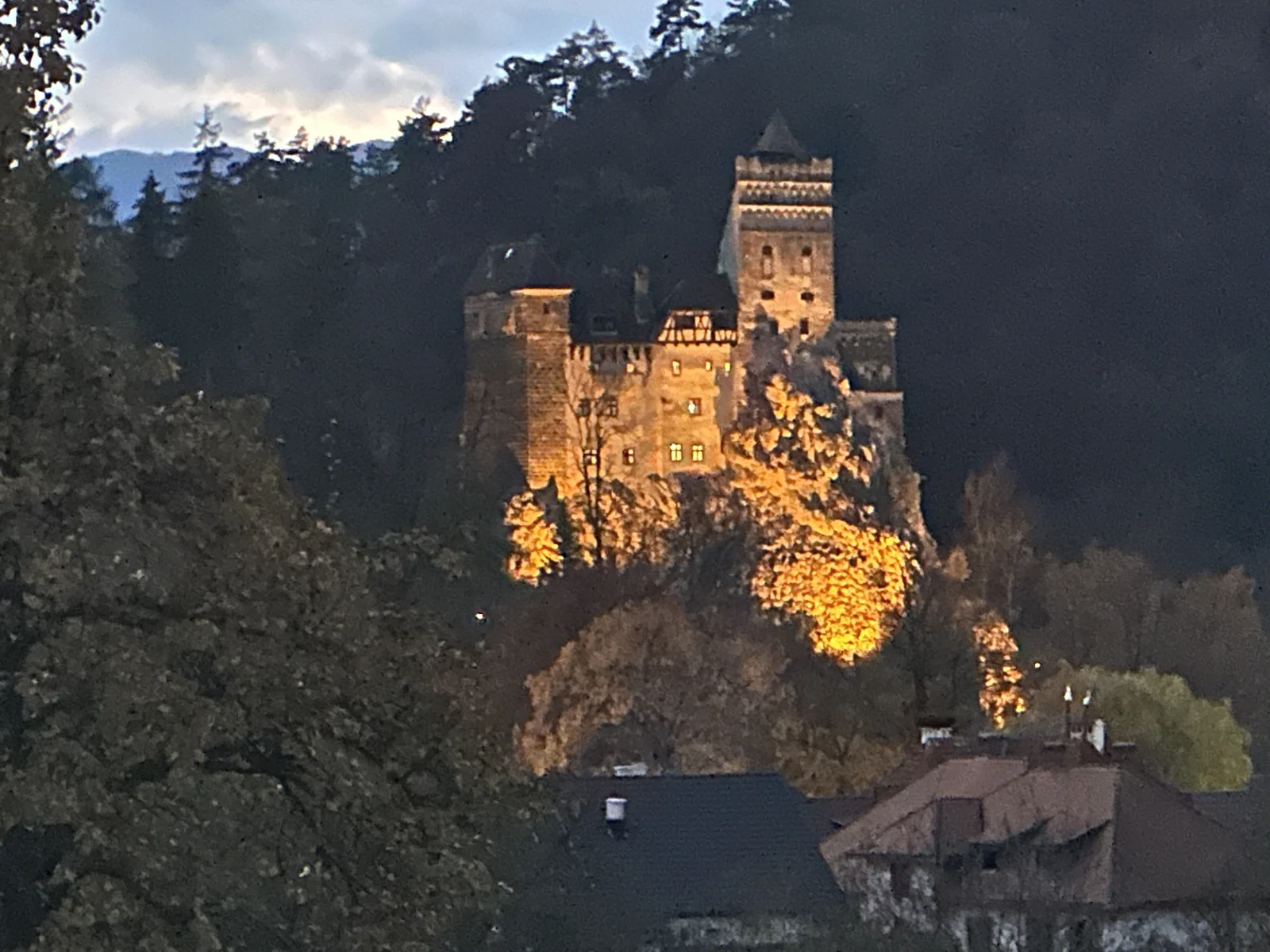
Poenari Castle in Wallachia, in southern Romania, really was a fortress of Vlad III, the 15th-century prince known as Dracula. It became famous through Radu Florescu and Raymond McNally’s book In Search of Dracula (1972) and the film documentary that followed, in which Christopher Lee compared it with the castle in the novel. But Bram does not name it in the novel and probably never knew of it. A link to the real Vlad does not make it the home of Bram’s fictional Count.
Corvin Castle (also called Hunyad Castle), in Hunedoara in western Romania, is another popular stop on Dracula tours, because of a legend that Vlad III was once held prisoner there. It has no link with the novel. Orava Castle in Slovakia is famous because the 1922 silent film Nosferatu, an unofficial version of Dracula made without permission, was filmed there. It is a film location, not one of Bram’s.
Bran Castle is operated by Bran Domain Management Company (Compania de Administrare a Domeniului Bran, CADB). In May 2026, Joel Weinshanker’s Ad Populum group was reported to have acquired an 80% controlling stake in that operating company through VT Bran. Weinshanker is also involved in managing Elvis Presley’s Graceland. Read the May 2026 report.
For a classroom discussion, try the Bran Castle question on Studying Dracula and the printable evidence sheet, including one possible answer.
What our shaded area means
Our map deliberately shades a large area that takes in the Borgo Pass, the route towards Dornișoara and the Călimani caldera. That way it covers both main readings without making it look as if the Estate has settled the argument.
The shading is only a guide. It is not a historical border, and it does not mean that every point inside it is equally likely. There are no castle ruins to find. Somewhere in this landscape Bram imagined his castle; whether he had one exact mountaintop in mind is still being debated.
Explore Castle Dracula and the other places in Bram’s fiction →
Reference documents and further reading
- Bram Stoker, Dracula (1897), particularly Chapters 1–4 and 26–27. The published story supplies the route, landscape and latitude clues.
- Bram Stoker, Dracula: notes and outline, c. 1890–1896, held by The Rosenbach, Philadelphia. The working material should be distinguished from the finished novel.
- Robert Eighteen-Bisang and Elizabeth Miller, eds., Bram Stoker’s Notes for Dracula: A Facsimile Edition (McFarland, 2008). Facsimiles and annotated transcriptions for comparison with the novel.
- Annotated editions of Dracula by Leonard Wolf, Clive Leatherdale and Leslie S. Klinger (The New Annotated Dracula, 2008). Examples of the ‘no exact spot’ reading.
- Hans Corneel de Roos, Castle Dracula: Its Exact Location Reconstructed from Stoker’s Novel, His Research Notes and Contemporary Maps (2012). The detailed reconstruction of a specific intended site.
- Paul Murray, ‘A Tour of Dracula’s Transylvania’, Journal of Vampire Studies 3 (2023), pp. 7–30. A critical examination of the geographical argument.
- Hans Corneel de Roos, ‘Exploring the Route to Castle Dracula: A Reply to Paul Murray and Brian Coffey’ (2025), pp. 3–34. See also the author’s maps and corrected illustrations.
- Bram Stoker and Cruden Bay – A Walking Guide (PDF), particularly its discussion of Slains Castle, proposed influence and direct evidence.
For the wider travel books, folklore and research, see What inspired Dracula.
- Laura Eastlake, “The Volcano and the Vampire: The Case for a Volcanic Gothic”, Gothic Studies 27:1 (2025), pp. 58–77. An open-access author version is available from the University of Glasgow.