
Whitby walk · Stop 1 of 6
6 Royal Crescent – West Cliff
Holiday lodging · late July–August 1890
Start with a holiday address before following the novel down into the town. Royal Crescent gives the walk a sense of the everyday Whitby from which its darker stories grew.
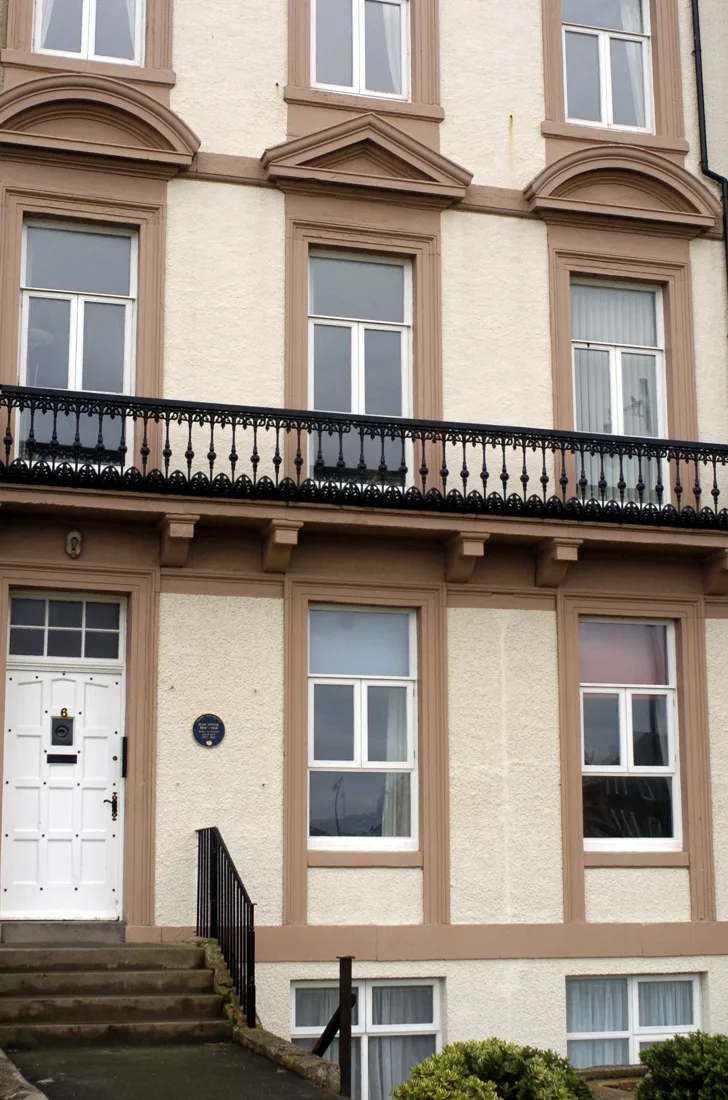
Look along the sweep of Royal Crescent to the plaque at No. 6. Bram arrived at Mrs Veazey’s lodging house here in late July 1890, by train from King’s Cross, and Florence and Noel joined him about a week later.
The family’s holiday took in Mulgrave Woods, Robin Hood’s Bay and the town’s Water Fete. Bram also read, walked and took notes, gathering material for a novel that would not appear until 1897.
That novel opens its Whitby chapters on this side of the harbour. Mina arrives on 24 July and drives up to “the house at the Crescent” where Lucy’s family have rooms. Later, the Count’s Whitby solicitor, Mr S. F. Billington, is given the address 7 The Crescent – next door, if the novel’s Crescent is this one.
Look for
The house number and commemorative plaque at No. 6, and No. 7 beside it. Then step back to take in the curve of the terrace, the setting Mina calls simply “the Crescent”.
Read
“Lucy met me at the station, looking sweeter and lovelier than ever, and we drove up to the house at the Crescent in which they have rooms. This is a lovely place.”
“This cargo was consigned to a Whitby solicitor, Mr. S. F. Billington, of 7, The Crescent, who this morning went aboard and formally took possession of the goods consigned to him.”
Evidence
Whitby Museum documents the lodging, the arrival and the family’s visit. Reading the novel’s “Crescent” as Royal Crescent is an inference from the text; no real Whitby solicitor called Billington has been traced.
Practical information
Private property: view the exterior and plaque from the pavement.
Whitby Museum: Bram’s 1890 visit →
Walking to the next stop Follow the West Cliff public streets towards the Whalebone Arch and the top of Khyber Pass, where the view opens over the harbour.
Give feedback on the Whitby walk →