
resources
Practising and revising Dracula
Build a flexible knowledge of the novel by choosing questions, testing evidence and revisiting your answers. Use the seven-step essay guide to develop a researched response.
Quotations and evidence
Open the quotation bank, key terms and critical readings. The quotations are grouped by subject and cited by chapter. Read the surrounding passage before selecting a quotation for your argument.
For each quotation, record its speaker, document and place in the plot; explain one detail of its language; then find another passage that complicates your reading. At step 5 of the essay guide, choose the key quotations and place them against the claims in your plan.
A bank of 40 practice questions
Choose from 20 single-text and 20 comparative questions, grouped by subject. These are original practice questions for this guide, separate from official examination papers. For comparison, use the texts permitted by your course.
Avoiding common mistakes
Examiners’ reports describe recurring weaknesses in real answers. Use the points below to improve preparation essays and revision. The reports come from different qualifications and years: a shared principle may travel across courses, but a paper’s assessment rules do not.
1. Answering the question you prepared instead of the question asked
A familiar subject can conceal an unfamiliar task. In 2023, OCR criticised answers that reshaped the question to fit prepared gender material; Pearson’s 2019 closing advice likewise warns against forcing prepared points into an answer.
A better approach. Write a one-sentence answer to the actual question before selecting material. If the question asks how suspense is created, an account of Victorian gender expectations earns its place only when it explains that suspense. Rebuild the order and judgement when the wording changes. OCR 2023; Pearson A-level 2019, p. 94.
2. Letting context replace the writing
General accounts of Victorian society, Gothic periods or imperial anxiety can overwhelm the literary argument. OCR’s reports distinguish knowledge that illuminates a text from background material that takes attention away from it.
A better approach. Start with a precise moment, identify a relevant historical or literary connection, then explain what it reveals about the language, form or effect. Check dates and distinguish a novel’s publication from its setting. For example, the 1905 Aliens Act cannot be treated as a law already in force when Stoker published in 1897. OCR 2019; OCR 2024; worked paragraph on context.
3. Turning biography into proof of a fictional meaning
A resemblance between an author’s experience and a character does not establish direct inspiration. Pearson’s AS 2025 report criticises simplistic biographical connections, while OCR 2023 warns about reductive judgements based on poorly informed biography.
A better approach. Distinguish a documented fact, a useful comparison and a claim of influence. Charlotte’s public work can illuminate questions about Mina’s agency; it does not prove that Mina was based on her. Florence’s later management of Bram’s legacy is a comparison, not evidence of an influence before 1897. Pearson AS 2025; OCR 2023; Charlotte and the evidence.
4. Reducing characters to convenient labels
Calling Lucy a transgressive woman punished for desire, or Mina an obedient Victorian wife, can substitute a prepared category for an interpretation. OCR 2022 found gender readings narrowing the novel; AQA 2023 wanted attention to the different roles Mina performs.
A better approach. Test the label against changes in action, voice and circumstance. Distinguish Lucy’s joking letter from her later assault and transformation. Place Mina’s language of service beside her intellectual work and the men’s exclusion of her. A contradiction can become the argument rather than an exception to dismiss. OCR 2022; AQA 2023; Mina example essay.
5. Relying on the same few scenes
The castle encounter and Lucy’s destruction are powerful evidence, but cannot stand for every dimension of the novel. OCR 2022 criticised an extremely restricted range; its 2024 report welcomed attention to less frequently discussed characters such as Renfield.
A better approach. Build an evidence map across the whole book before selecting a manageable set for this question. Consider the Demeter, Lucy’s treatment, Renfield’s warning, Mina’s compilation, the pursuit and the final Note. Choose passages for their contribution to the argument, not simply to demonstrate coverage. OCR 2022; OCR 2024; chapter map.
6. Naming a feature without explaining how it works
Identifying an adjective or announcing that the novel is epistolary is a starting point. AQA 2023 criticised weak attention to narrative perspective and methods; Pearson’s AS 2023 report encouraged discussion beyond isolated words and episodes.
A better approach. Explain how the choice shapes meaning. Who records the event? What can that speaker know? How does an earlier document change the reader’s understanding? Analyse chronology, delayed disclosure and Mina’s editing alongside language. AQA 2023; Pearson AS 2023; narrative-form example.
7. Forgetting the Gothic imagination and its effects
Social and historical interpretation should still account for the experience of reading a Gothic novel. OCR 2023 identified neglected religion and supernatural belief; the 2024 and 2025 reports discuss entertainment and the imaginative effects of the genre.
A better approach. Ask how a scene generates dread, suspense, fascination, disgust or pleasure, and how its ideas contribute to that effect. A social explanation and an account of Gothic storytelling can strengthen one another. Test whether a reading explains why this particular sequence is frightening or unsettling. OCR 2023; OCR 2024; OCR 2025.
8. Comparing events without developing a shared argument
Two similar incidents do not by themselves make a meaningful comparison. Pearson’s AS 2023 report distinguishes comparisons of events from exploration of ideas; the 2025 report criticises tenuous or asserted connections.
A better approach. Make a claim about a shared issue, analyse evidence from both texts, then explain the significance of the difference. A hidden portrait and an absent reflection become useful together when you explain what each makes visible, who can see it and how it unsettles trust in appearances. Pearson AS 2023; Pearson AS 2025; worked comparison of images.
9. Remembering a film as though it were the novel
Adaptations can change motives, relationships, events and endings. OCR 2024 explicitly reminds candidates to distinguish the novels from their film versions.
A better approach. Verify every event against the text and identify an adaptation by title and date when you discuss it. The reincarnated romance in Coppola’s 1992 film, for example, cannot establish Dracula’s motive in Stoker’s novel. Use the adaptation guide for comparison, then return to the passage. OCR 2024.
10. Applying one paper’s requirements to another
The qualifications assess different tasks and objectives. Advice about an OCR comparative essay cannot simply be transferred to its unseen appreciation, AQA’s combined course or a Pearson AS paper.
A better approach. Use your own specification and mark scheme. OCR H472/02 emphasises AO2 in the unseen and AO3 in the comparative essay. Pearson’s AS 8ET0/02 does not assess AO5; named critics are useful there only when they serve an assessed purpose. The A-level 9ET0/02 mark scheme also assesses AO1–AO4. AQA 7707 requires precise linguistic and literary analysis of its extract and the wider novel. OCR 2025; Pearson AS 2023; Pearson A-level mark scheme; AQA 2023.
Try revising a paragraph
Too general: “Victorian women were expected to obey men, so Mina is a traditional wife.”
More precise: “Mina learns shorthand and typing to become ‘useful to Jonathan’ (Chapter 5), but her insistence that ‘dates are everything’ (Chapter 17) turns those accomplishments into a method on which the whole alliance depends. Her conventional explanation of usefulness does not fully account for the intellectual authority her work gives her.”
The revision connects a historical issue to words, sequence and an argument. Its value depends on the question: it would need a different emphasis in an essay about suspense or documentary evidence.
For OCR unseen practice: let the passage supply the evidence
OCR 2022 reports candidates assuming that pale figures in an unseen passage must be vampires. Read the headnote, narration and sequence before importing an explanation from your set texts. Wider reading can illuminate the passage; it cannot establish events the passage does not describe. Read the OCR report.
Before keeping a paragraph: does it answer the question, use accurate evidence, analyse a method, justify its context and advance the argument? In comparison, does it explain a meaningful relationship between the texts? Your teachers will guide you on examination technique; these checks help you prepare knowledge you can use flexibly.
Practise with plans and paragraphs
Choose a question and make an evidence grid before drafting. Work through four example preparations and essays, then try the process with a different question. The existing worked plans offer further starting points.
Return to an earlier paragraph after rereading the novel. Strengthen its evidence, test the alternative explanation and revise the judgement. Keep a note of what changed and why.
Official papers, mark schemes and reports
Find official papers by qualification. The tasks differ: some are single-text, some comparative, and some begin with a supplied extract. Read the instructions and the associated mark scheme together; use the examiners’ reports to understand common strengths and weaknesses.
Short texts by Stoker for unseen practice
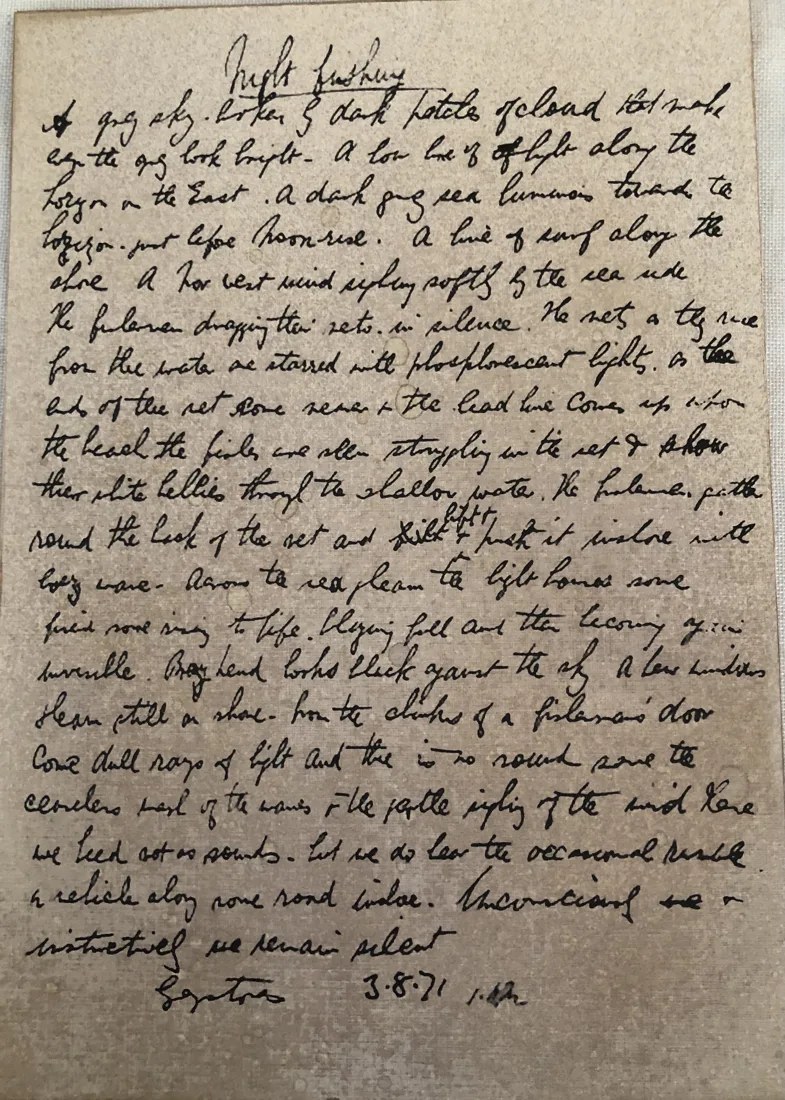
Several courses include an unseen Gothic passage. Practising on Stoker’s own shorter fiction lets students meet his habits of narration in a new setting.
- “The Judge’s House” (1891). A student seeks quiet lodgings in a house with a reputation. About 7,700 words; in Dracula’s Guest and Other Weird Stories (1914) and free at Project Gutenberg (ebook 10150). The opening 1,000 words make a complete unseen exercise on setting, rational narrator and rising dread.
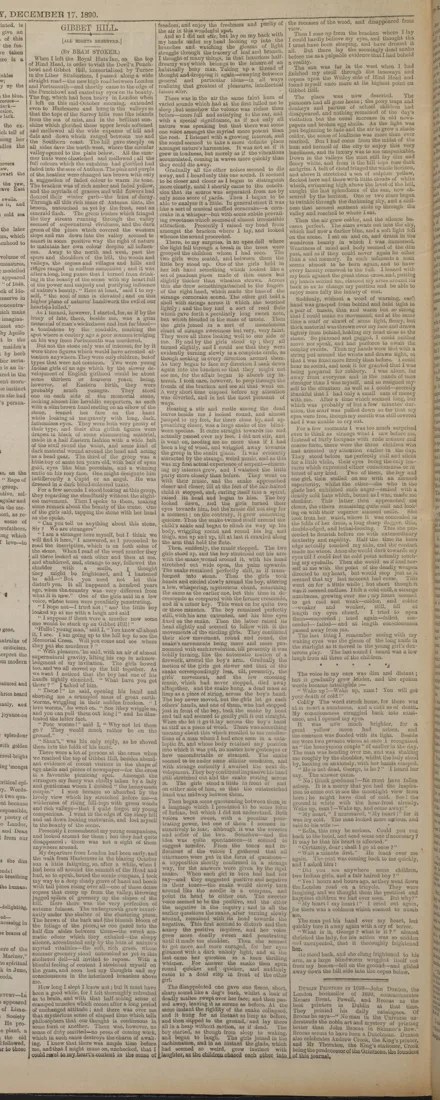
- Gibbet Hill (1890). A story rediscovered in the National Library of Ireland and announced in October 2024, first published in the Daily Express (Dublin) Christmas supplement of 17 December 1890. A walker on a Surrey hilltop, the memorial to a murdered sailor, three strange children and a blindworm: short enough to read in one lesson and absent from every study guide. The original newspaper pages are linked from Gibbet Hill; a book edition with a foreword by Roddy Doyle followed in 2024.
- “Dracula’s Guest” (1914). Published after Bram’s death; about 4,900 words; an Englishman caught in a snowstorm near Munich on Walpurgis Night. Discuss its relation to the novel with care. Florence Stoker’s 1914 preface calls it an episode “originally excised owing to the length of the book”; the familiar claim that it was the novel’s deleted first chapter goes further than that evidence.
- The Demeter log (Chapter 7). Within the novel, the log reads as a free-standing found document and makes an unseen-style exercise for students who have not yet read the whole book.
Build an evidence notebook you can adapt
- Keep the passage, not only the phrase. Record a quotation accurately, with speaker, document and chapter. Add what happens immediately before and after it; this helps prevent an attractive phrase from acquiring a meaning the scene cannot support.
- Give evidence more than one use. Mina’s compilation can support arguments about technology, cooperation, gender and proof. Write a different explanation for each use. The words remain the same; their contribution to an answer changes.
- Include a challenge. Pair a passage that supports your claim with one that limits it. Do not call Mina wholly excluded without recognising the work she continues to perform; do not call the ending wholly secure without reading the final Note.
- Keep comparison paired. For a comparative course, place the two passages on the same page of your notebook. Record a similarity, a significant difference in method and a relevant difference in context. Use the pairing guides to begin, then select your own evidence.
Adapt a prepared argument to a new question
Preparation is useful when you can change what it does. Begin with your answer to the new question, then decide what the earlier work can contribute.
| Prepared topic | New question | What must change |
|---|---|---|
| Mina’s traditional and modern qualities | How does Stoker create suspense through unequal knowledge? | Use her compilation and exclusion to explain reader expectation and delayed discovery; background about the New Woman is relevant only where it explains the method. |
| Foreignness and belonging | How far does the novel celebrate cooperation? | Weigh Van Helsing and Morris’s contribution against the silencing of Renfield and marginal witnesses; cooperation becomes a contested judgement. |
| Respectability and desire | Compare how two writers use concealed spaces. | Organise around rooms, access, observers and revelation, with evidence from both books. A prepared account of Victorian morality is not an answer by itself. |
Write a fresh opening and a three-point plan before revising an old paragraph. If the paragraph does not serve the new answer, set it aside. The essay guide and examiner feedback explain why this matters.