
London walk · Stop 3 of 15
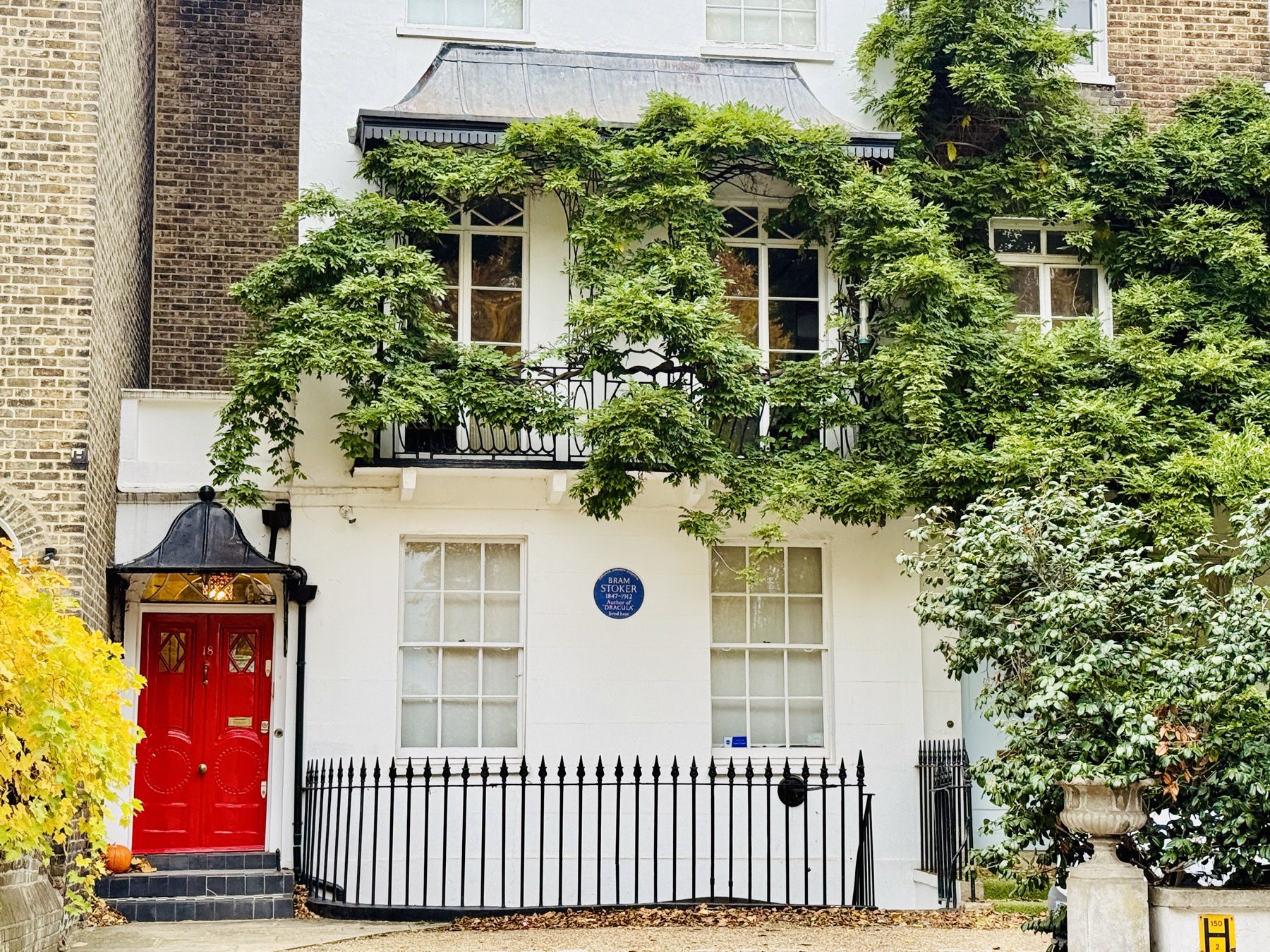
17–18 St Leonard’s Terrace – the blue plaque
Family homes · No. 17 about 1884–86; No. 18 about 1896–1906
A familiar blue roundel can make a writer seem settled in one place. The story behind this one is more mobile: adjoining homes, journeys across London and a book assembled over years.
Look up at the blue plaque on No. 18. The Greater London Council put it up in 1977, and it names Bram as the author of Dracula.
The family moved into No. 17 in about 1884 and later lived next door at No. 18, from about 1896 to 1906. Much of Bram’s work on Dracula, published in 1897, belongs to these Chelsea years. From this street he went out to research at the London Library and to earn his living at the Lyceum, both later on this walk.
The Lyceum could reach him here at any hour. Before dawn on 18 February 1898 a cab-driver knocked with a letter from Bow Street police station: the Lyceum’s scenery store in Southwark was on fire.
Look for
The blue plaque on No. 18 and the house numbers on both doors. Photograph plaque and numbers together so the neighbouring addresses stay distinct.
Read
“At ten minutes past five on the morning of Friday, 18th February 1898, I was wakened by a continuous knock at a door somewhere near my house in Chelsea.”
Evidence
The 1977 plaque records Bram’s residence but gives no dates. The house numbers and years rest on directory evidence and are approximate; census returns would settle them. Bram’s 1898 account names only “my house in Chelsea”.
Practical information
Private houses: view the plaque from the pavement.
English Heritage: Bram Stoker plaque ↗
Next: Follow the pavement east along St Leonard’s Terrace towards Durham Place, the next Chelsea stop.
↑ Return to map from stop 3: 17–18 St Leonard’s Terrace – the blue plaque
Source references
Bram Stoker’s Chelsea home — English Heritage blue plaque record